
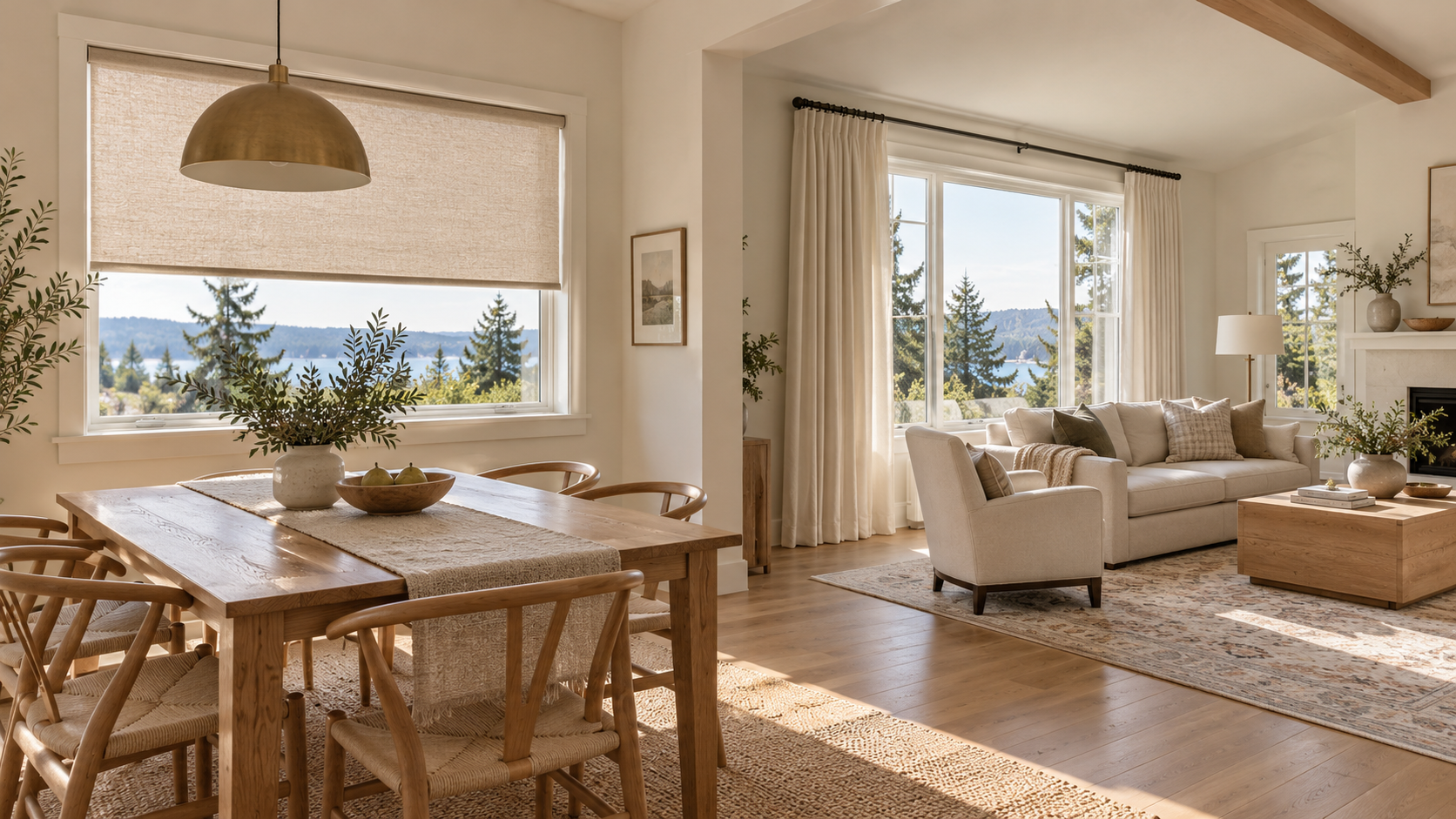
Your window treatments can work together without being identical. Choose the light control and privacy each room needs, then repeat a few visual details across the home. A consistent color direction, texture or hardware finish can connect different styles without making every room use the same shade.
That approach is useful in Greater Seattle homes where a living room, kitchen and upstairs bedroom may face different directions or neighboring windows. Start with how each space is used, then look at what you can see from one room to the next.
Quick takeaways
- Choose each room’s light control and privacy before deciding what should match.
- Coordinate windows that share a sightline more closely than rooms behind closed doors.
- Compare samples together in your home, including their street-facing sides.
- Keep a room-by-room record if you plan to order in stages.
Start with a simple room list
Write down what you want each window treatment to do. A bedroom may need stronger light blocking, while a dining nook may benefit from softened daylight. A window beside a television has a different job from one looking onto a private garden. These differences are a good reason to compare products instead of copying one choice everywhere.
For each room, note when you use it, where unwanted light comes from and whether people outside can see in. Check evening conditions as well as daylight. Rainier’s light-filtering roller shade options soften daylight, but privacy depends on the fabric and lighting. Blackout fabric has a different purpose, and the mount and fit still affect light around the edges.
Once that list is clear, decide which treatments need to close daily and which will mainly add softness or frame a view. The same color cannot make two different fabrics perform the same way.
Use shared sightlines to decide what should coordinate
Stand where you normally enter the home, sit on the sofa or look across the kitchen. Which windows appear together? Those groups deserve the closest attention. You might repeat a warm-white fabric direction across the living and dining areas while choosing a different shade construction for each opening.
Two windows side by side usually look more deliberate when their main details relate to one another. Across an open-plan room, compare the visible headrails, the scale of the fabric texture and the heights where treatments will sit. Different window shapes or mounting conditions may prevent exact alignment, so review the actual layout before promising a perfectly level visual line.
A bedroom down a hallway has more freedom. It can suit its own paint, bedding and light-control needs without repeating the treatment used over the kitchen sink. Look at the home from normal viewing positions rather than judging every window as if it were on the same wall.
Repeat a few details rather than every detail
Pick one main connection first. That might be a family of warm neutrals, a simple fabric texture or a consistent hardware finish. Then decide where you want a change. For example, an oatmeal roller shade in a dining nook can sit comfortably beside ivory drapery in the living room when the surrounding finishes support both.
Compare actual samples instead of relying on names such as “white,” “linen” or “natural.” Similar names do not establish an exact color match between fabrics. Put the samples beside your trim, flooring and upholstery, then view them together at the windows where they will be installed. Keep the options that still feel related in your own light.
Coordinating different treatment types is also a recognized design approach. Hunter Douglas’s Whole House Solution pairs complementary products across window types. That is a manufacturer-specific example of the principle, not a claim that Rainier carries that program or can supply identical fabrics across every style.
Design reference — Hunter Douglas Whole House Solution
Let different rooms use different styles
A whole-home plan might combine roller shades in everyday spaces, cellular shades in bedrooms and drapery where you want a softer finish. Treat that as a starting point for comparison, not a package every house needs. Rainier’s indoor shade selection includes light-filtering and blackout cellular options, along with roller, zebra, Roman and woven wood styles.
If you like Roman or woven wood shades, include operation in the decision: Rainier offers those styles with motorized operation only. Confirm controls for every other selected product rather than assuming the entire order will use one system.
Drapery introduces another set of details. Compare the fabric with nearby shades, but also consider the mounting position, fullness and where the panels will rest when open. A coordinated color is only part of a successful combination; the hardware and moving fabric need to fit the space too.
Check the view from outside
Before finalizing street-facing rooms, look at the back of each sample. The room-facing color and the exterior-facing surface may differ. Ask which linings or backing colors are available for the exact products you are considering; do not assume every treatment has a white reverse.
Bali’s curb-appeal guidance illustrates how neutral liners can connect different treatment types from outdoors. Walk outside to compare your own windows in daylight and after interior lights are on. If your property has HOA or condominium requirements, obtain the actual requirements before ordering rather than relying on a general rule about backing colors.
Design reference — Bali curb appeal guidance
Keep the plan if you are ordering in stages
You can plan the whole home while purchasing only the rooms that matter now. Record each selected product, collection, color code, lining and hardware finish, along with the window location. Keep a labeled sample when available.
When you return for another room, compare current samples with the installed treatments. Ask whether the earlier fabric is still available; do not depend on future availability or an exact match from memory. A deliberate coordinating choice is often easier to evaluate than a near-match chosen from an old phone photo.
Common questions
Should every room use the same fabric color
No. Repeat colors where you want continuity and vary them where the room calls for it. Check neighboring spaces together, especially when you can see several windows from one seat or doorway.
Can I mix shades and drapery across the house
Yes. Choose each for its role, then compare the fabrics and visible hardware. If you want both on one window, plan their mounting depth and movement together rather than selecting them separately.
Do matching treatments provide matching privacy
Not necessarily. Similar-looking fabrics can have different light-control properties, and privacy changes with lighting. Discuss the exact fabric and intended room use before approving the order.
Compare the options in your own home
Rainier Blinds brings samples, measures your windows and prepares pricing for your selections. Book an in-home consultation to compare a room-by-room plan without committing to identical treatments everywhere.
Consultations are free within 60 driving miles of Auburn, WA. Farther-away projects are considered individually, with any consultation fee quoted before booking and credited toward your order. There is no obligation to order.