
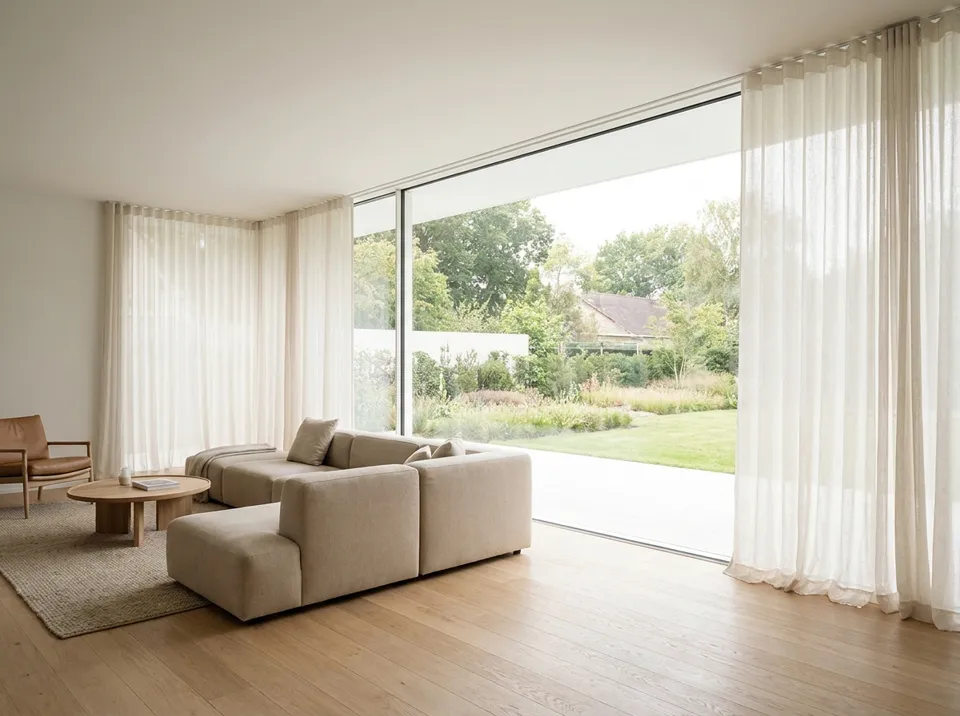
Sliding glass door shades in Auburn, WA have to do a job no ordinary window covering can: cover 6 to 12 feet of glass, survive daily traffic, and still leave the door free to slide. This 2026 guide covers the four treatments that actually work on patio and backyard doors — vertical cellular shades, drapery panels on a track, sunscreen and motorized roller shades, and dual day/night systems — plus the wide-opening measuring rules that decide whether the finished job fits or binds.
TL;DR
- Vertical cellular shades are the best all-around pick for sliding glass doors in Auburn, WA in 2026.
- Drapery panels on a traverse track win for finished living rooms; motorized sunscreen roller shades win for glare and decks.
- Stock door coverings from a big-box shelf rarely fit wide or out-of-square openings.
- Measure the full opening at three widths, not one panel — this is where self-measure orders fail.
- Rainier Blinds measures in your home, has your shades custom-made to your measurements by a wholesale supplier, and installs with our own crew.
Key numbers
Why this matters
A sliding glass door is the biggest single sheet of glass in most Auburn homes, and it is the opening the family walks through every day. Whatever covers it gets pulled, brushed past, and slammed sideways in a way no bedroom shade ever experiences. A treatment that looks fine on a showroom sample rack — or on the standard chart at a big-box store — fails on a real patio door in three predictable ways: the track sags over a wide span, the stack of fabric blocks half the doorway when open, or the bottom rail drags on the threshold every time someone carries groceries through.
There is a second, local problem. Auburn homes back up to decks, greenbelts, and west-facing yards from Lea Hill to Lakeland Hills, and a west-facing slider takes the full low afternoon sun for half the year. Bare glass turns the family room into a greenhouse by 4:00 PM and bleeds heat out through the same glass all winter. The right door covering is therefore a comfort and energy decision, not just a style one — the same logic behind our custom window treatments work across South King County, applied to the one opening where the stakes are highest.
Who this is for
This guide is for Auburn and South King County homeowners replacing a worn-out door covering, finishing a remodel, or outfitting a new deck or patio door in a newer build. It applies whether the door opens onto a Lakeland Hills backyard, a Lea Hill deck, or a townhome balcony in downtown Auburn.
It is not for commercial storefront glass — different hardware, different codes — and it is not for the window walls next to the door, which behave like windows and get standard shade treatment. If the door is rarely used and the room needs true darkness instead, the picks in our blackout shades Auburn WA guide apply; this page is about doors that get used daily.
What to look for in sliding glass door shades for Auburn homes
Measure the opening like a doorway, not a window
Patio doors are wide, and width is where treatments fail. A sliding door opening typically runs 60 to 144 inches across and about 80 inches tall, and older frames settle out of square the same way Auburn window frames do. The measuring rule a professional crew follows: three width readings at top, middle, and bottom, three height readings, and the tightest usable number on the order.
The second measurement most DIY orders miss is stack depth — how much room the fabric takes when the shade is open. On a door you walk through daily, the stack cannot hang in the traffic path or cover half the glass when open. Track projection, wall space beside the opening, and door handle depth all get checked at the measure visit, because any one of them changes the product that fits.
Vertical cellular shades: the insulating workhorse
Vertical cellular shades hang the honeycomb fabric on a track, so the vanes draw sideways like a curtain while each cell still traps still air against the glass. On a west-facing slider, that means glare control in August and lower heat loss on the same glass in January — the one door treatment that does both jobs. Cordless and wand operation keep the 2026 child- and pet-safety baseline, and battery or plug-in motors can draw the whole track open and closed on a schedule.
The trade: vertical cellular needs the most mounting depth of the four options, and a shallow header above the door can force an outside mount on a slim fascia. Check casing depth before falling in love with the look. For the full spec rundown on the product itself, see our vertical cellular shades for sliding glass doors guide.
Drapery panels on a traverse track
Custom drapery on a ceiling-mounted traverse track is the dressed answer for a patio door. The panels stack fully clear of the glass when open, clear the door handle when drawn, and add softness no hard covering can match. A blackout or thermal lining turns the same panels into a genuine light-control layer for media rooms and guest suites, and the track carries far more fabric weight than a decorative rod ever should.
The trade is stack space: full panels need 12 to 24 inches of wall or ceiling run beside the opening to stack into, which not every Auburn floor plan has. Where the wall is tight, a shallow-stack shade wins and the drapery moves to the windows beside the door instead. See our custom drapery panels for sliding glass doors guide for hardware and fabric detail.
Sunscreen and motorized roller shades
A wide sunscreen roller shade on a slider cuts glare and UV while keeping the view to the deck — the right call when the door faces west and the room is used in the afternoon. Roller fabric spans large widths cleanly, the flat panel never blocks the door path when raised, and pairing a sunscreen roller on the door with blackout cellular or roller shades on the surrounding windows gives each opening the fabric it needs.
Motorization earns its cost here more than anywhere else in the house. A slider-sized shade is wide and heavy to pull by hand, sits behind furniture, and gets operated at the exact hours you least want to walk over — dinner glare, movie start, summer dusk. Battery motors recharge roughly every 6 to 12 months depending on cycle count, and the installing crew sets travel limits so the bottom rail never kisses the threshold.
Dual day/night for doors that do two jobs
A dual (day/night) system stacks a sheer or sunscreen layer with a blackout layer on one track or cassette. Daytime runs on the sheer; movie nights and guest-room darkness come from the blackout layer. On a patio door this replaces the older habit of hanging a second product a year later, and one headrail means one measure, one install, one warranty conversation.
Controls for a door the whole family uses
Whatever product wins, the control matters as much as the fabric on a daily-use opening. Cordless lift and wand traversal are the 2026 baseline anywhere kids or pets cross the room. Continuous-loop chains on wide doors wear out fastest and snag on passing traffic — treat them as a skip on any door in the walking path. Motorized tracks solve the reach and wear problems at once and pair with remotes or phone apps; hardwired motors suit new construction where electrical is already roughed in.
Top picks for Auburn and South King County
The safe pick: vertical cellular shades
The everyday pick. Insulation on the biggest glass in the house, side-to-side operation that clears the door path, and custom track lengths for wide and out-of-square openings. Buy for any slider the family walks through daily, especially west-facing doors on older glass. Custom-made to your measurements after an on-site measure, not cut from a stock chart.
The finished-room pick: custom drapery on a traverse track
The dressed pick. Floor-to-ceiling panels that stack fully open, clear the handle, and take a thermal or blackout lining where the room needs it. Buy for living rooms and primary suites where the door reads as part of the room's design. Confirm the stack wall space at the measure visit — panels need room to live when open.
The glare pick: motorized sunscreen roller
The deck-view pick. One flat panel that disappears above the door when raised, cutting afternoon glare and UV without touching the view. Buy for west-facing doors, doors behind sectionals, and anyone tired of dragging a heavy shade by hand. Budget the 6-to-12-month battery recharge on high-cycle doors.
The flexible pick: dual day/night system
The two-jobs pick. Sheer for the day, blackout for the night, one track. Consider for media rooms and guest suites built around a slider, where the same door serves bright mornings and dark movie nights. Needs the deepest mounting depth of the four — verify header space first.
What to avoid
Off-the-shelf door coverings from a big-box shelf
Stock door coverings come in fixed widths, and Auburn sliders are not fixed widths. A covering cut to the nearest catalog size leaves light gaps at the jambs, sags over wide spans, and drags at the threshold on settled frames. On a 96-inch opening, two inches of error is a bright stripe down one side and a bottom rail that scuffs every trip to the deck.
One fabric for the door and every window in the room
The door and the windows beside it do different jobs. The door faces the deck and takes direct glare; the flanking windows face the yard and hold privacy needs. Forcing one product house-wide usually ends with a remake — pick the door's fabric for its own job and let the windows keep theirs.
Self-measure orders placed online
Custom fabric cut to uploaded numbers is rarely returnable, and a slider exposes every error across 10-plus feet of track. Handle depth, track projection, and out-of-square frames never show up in a phone-photo measurement. A local measure costs less than one remake.
Verdict comparison
| Option | Best for | Key detail | Verdict |
|---|---|---|---|
| Vertical cellular shades | Daily-use doors, older glass | Insulating cells on a track | Buy |
| Custom drapery, traverse track | Formal living rooms, suites | Full stack clearance + lining | Buy |
| Motorized sunscreen roller | West-facing doors, decks | Flat panel, recharge 6-12 mo | Buy |
| Dual day/night system | Media rooms, guest suites | Two fabrics, one track | Consider |
| Off-the-shelf stock sizes | None in practice | Fixed widths, light gaps | Skip |
How local measure, custom-make, and install works
We bring fabric samples to your home and help you choose the weave, texture, and finish in your own light. Your door treatment is custom-made to your measurements, and our local crew handles measuring and installation.
- Consult and measure: on-site — full opening width and height at three points each, handle and threshold clearances, wall space for the stack, and header depth for inside or outside mount.
- Quote on the spot: real pricing before we leave, covering the door and any windows in the same project, including track hardware and any motorization. No showroom visit required.
- Custom-made by the supplier: fabric and track built to your measurements, typically arriving 2-4 weeks after the order is confirmed.
- Install: usually one visit. Track level checked, travel limits set on motors, and door operation tested before the crew leaves.
Coverage and scheduling details for Auburn jobs sit on the Auburn service area page. The free quote starts with a measure visit, not a showroom appointment.
FAQ
What are the best shades for sliding glass doors in Auburn, WA in 2026?
Can you put roller shades on a sliding glass door?
How do you measure a sliding glass door for shades?
Do vertical cellular shades insulate a patio door?
Can shades on a sliding glass door be motorized?
What is the difference between vertical cellular shades and drapery panels for patio doors?
How long does it take to get custom sliding door shades?
How much do sliding glass door shades cost in Auburn, WA?
One last thing
The detail most homeowners miss is the open-door test. A door treatment that looks great drawn closed can still fail the room if, when open, its stack covers a third of the glass or hangs where shoulders pass through. Before you sign the order, ask the measuring crew to confirm two things in writing: where the stack lives when the shade is fully open, and how much clearance the bottom rail holds at the threshold.
Then walk the path you actually take through that door — groceries, laundry baskets, kids — during the measure visit. The right product for a door you cross 20 times a day is a different answer than the right product for the showroom.