
Our available controls: Rainier Blinds offers Roman and woven wood shades with motorized operation only. All other shade styles are available with manual, motorized, or smart control. Your consultation confirms the controls and power options for your product.
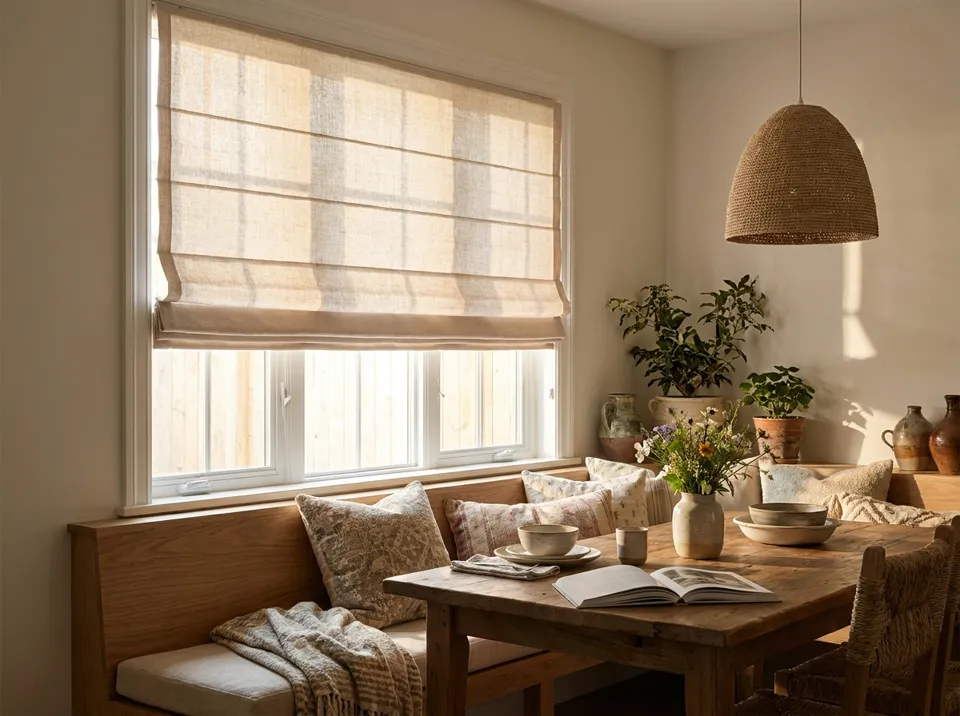
Roman shades in Puyallup, WA trade a flat fabric face for tailored horizontal folds that stack neatly at the top of the window when raised. This 2026 guide covers fold style, lining options from light-filtering to blackout, cordless lift, mount choices for Puyallup's mixed housing stock, and how a local crew that measures, has shades custom-made, and installs keeps the fit tight on older and newer frames alike.
TL;DR
- Roman shades Puyallup WA homes choose in 2026 when they want tailored fabric folds instead of a flat roller face.
- Light-filtering linings suit dining and living rooms; blackout linings suit primary bedrooms and shift-work sleep.
- Flat-fold styles read modern on newer Puyallup builds; relaxed and soft folds suit older Craftsman and farmhouse frontages.
- Rainier Blinds measures, has shades custom-made to your exact measurements, and installs Roman shades with our own crew.
Key numbers
Why this matters
Puyallup runs from Craftsman-era homes near downtown to newer construction off South Hill and Sunrise, and the window trim depth on each end of that range is rarely the same. Roman shades solve a problem flat rollers and cellular shades do not: a softer, tailored look that still functions as real light and privacy control, not just decoration. That makes them the 2026 default for dining rooms, formal living rooms, and bedrooms where homeowners want fabric folds instead of a flat tube face.
South King County light is flat and gray most of the year, then sharp and low-angled in summer. A Roman shade with the wrong lining either washes out a west-facing dining room at 6 p.m. or leaves a primary bedroom too bright at 5:30 a.m. in July. Getting lining and fold style matched to the room is the actual job, not picking a fabric pattern off a swatch card.
Stock Roman shade kits assume square openings and a shallow fold stack. Puyallup homes built before the 1990s often settle out of square by a 1/4 inch or more, which shows immediately in a shade with structured horizontal folds. Uneven folds are far more visible than an uneven roller edge. A measuring crew that visits the Puyallup service area in person, takes three widths and three heights, and has the shade custom-made to the tightest usable number is what keeps Roman shade folds stacking evenly for the next decade.
Who this is for
Puyallup and South King County homeowners finishing a remodel, replacing dated stock coverings, or furnishing a formal dining or living room who want a tailored fabric look with real opacity control. If you like the softness of fabric folds over a flat roller face, want a shade that still reads as furniture rather than hardware, or are pairing window coverings with drapery in the same room, this guide applies.
It is also for buyers comparing Roman shades to cellular or roller shades and wondering which wins on a specific window. Roman shades win when the room's style calls for fabric texture and a finished, tailored look. Cellular shades win when trapped-air insulation on an older single-pane window is the main job. Roller shades win when a clean, flat modern face matters more than fold texture. Many 2026 packages in Puyallup mix all three by room, our custom window treatments guide covers that room-by-room matching in more depth.
This is not a guide for renters hunting temporary stick-on coverings, and it does not cover products outside the shade and drapery range Rainier Blinds measures and installs.
What to look for in Roman shades for Puyallup homes
Fold style: flat, relaxed, or soft
Roman shade folds come in a few standard constructions, and the style changes the whole personality of the window.
- Flat fold: crisp horizontal pleats with a tailored, architectural look. Reads modern and works on newer South Hill and Sunrise construction with clean trim lines.
- Relaxed fold: a gentle scallop along the bottom edge when lowered, softer than flat fold without full ruffling. A common middle-ground pick for transitional rooms.
- Soft or hobbled fold: folds stay slightly visible even when the shade is raised, giving a more traditional, layered texture. Suits older Craftsman and farmhouse-style Puyallup homes.
Mixing fold styles across a house is normal. A flat-fold Roman shade in a modern kitchen and a soft-fold version in a formal dining room is a common 2026 pairing rather than a mismatch.
Lining: light-filtering, privacy, or blackout
The visible fabric on a Roman shade is only half the equation. The lining behind it does the actual light and privacy work.
- Light-filtering lining: softens daylight, keeps the room bright, minimal blackout effect. Standard for dining rooms and living rooms that stay occupied during the day.
- Privacy lining: blocks direct sightlines from outside without fully darkening the room, useful for street-facing rooms that still want daytime brightness.
- Blackout lining: a dense inner layer that blocks nearly all light when the shade is paired with a wide enough face fabric and a tight mount. Needed for primary bedrooms and any room used for daytime sleep.
Choosing the decorative fabric without specifying the lining is the most common Roman shade mistake in 2026. The pattern you see in a showroom sample rarely tells you anything about how dark the room will actually get.
Cordless lift and safety
Cordless lift systems are the 2026 safety baseline for any Roman shade within reach of kids or pets, the shade raises and lowers on a spring or cordless clutch mechanism with no loose cord loop. Continuous-loop cord lift still appears on some taller or wider Roman shades; treat a dangling loop as a skip unless the window sits fully out of reach.
Motorized lift is available on Roman shades and is worth the upgrade on tall dining room glass, stairwell windows, or any opening behind furniture where a cord or wand is inconvenient to reach daily. Rainier Blinds pairs motors with the same measure-and-install visit, motor and smart-home details live on the smart shades page.
Mount type on Puyallup's mixed housing stock
Inside mount tucks the shade within the window casing for a built-in look, but it needs real trim depth, shallow older Puyallup casings sometimes cannot fit the folded fabric stack cleanly. Outside mount covers the casing and forgives an out-of-square frame, which is common on homes built before the 1990s in the older parts of town.
A measuring crew records width and height at three points on the frame, not one center reading, so the shade is custom-made to the tightest usable number and folds stack evenly instead of binding on one side. This decision belongs on the in-home measure visit, not after fabric has been cut.
Pairing Roman shades with drapery for layered rooms
A Roman shade alone handles daily light and privacy. Adding drapery panels on a rod or track behind it adds a second layer for full-room darkening, extra insulation at the glass, or a more formal finished look in living and dining rooms. This layered approach is common in 2026 South King County remodels where a homeowner wants both function and a furnished appearance.
Drapery hardware and Roman shade brackets need to be planned together so the two layers do not collide at the top of the window. That coordination is a measure-visit conversation, not a decision made after either product ships.
Top picks for Puyallup and South King County
The safe pick: light-filtering Roman shades for dining and living rooms
The everyday pick. A flat-fold or relaxed-fold Roman shade in light-filtering lining softens glare while keeping the room bright enough to use all day. Fold depth typically runs 4 to 6 inches depending on style, which reads as furniture rather than hardware. Buy for dining rooms, formal living rooms, and any street-facing room in Puyallup that wants daytime privacy without going dark.
Check fold spacing at the measure visit. A shade cut too short leaves an odd half-fold at the bottom that looks unfinished in a room meant to be seen daily.
The bedroom pick: blackout-lined Roman shades
The sleep pick. Blackout lining behind a soft or hobbled fold gives a primary bedroom real dark for early summer sunrises while still reading as a tailored fabric window treatment rather than a utilitarian shade. Buy for primary bedrooms, guest rooms on east-facing glass, and any room used for shift-work daytime sleep.
Outside mount with a wide enough overlap matters more on blackout Roman shades than on any other lining. Side light gaps are the number one complaint on inside-mounted blackout Romans that were cut to the exact opening width.
The layered pick: Roman shades plus drapery panels
The finished-room pick. Pairing a light-filtering or privacy-lined Roman shade with drapery panels on a separate rod gives daily function plus a fuller, more formal look for living and dining rooms. Consider when a room is meant to be photographed or when extra glass-line insulation matters in a colder South Hill exposure.
This is a two-product job, so measure both together, bracket depth for the shade and rod projection for the drapery need to clear each other at the header.
The texture pick: relaxed-fold Roman shades on older Craftsman frontages
The character pick. A relaxed fold with a gentle bottom scallop suits the trim proportions of older Puyallup Craftsman and farmhouse-style homes better than a crisp flat fold, which can look out of place against period molding. Buy for front-facing rooms in pre-1990s construction where matching the home's existing character matters as much as function.
Flat fold is not wrong on these homes. It is simply a more modern statement. Decide the visual direction before the fabric is chosen, since fold style is not something that can change after the shade is built.
The hard-to-reach upgrade: motorized Roman shades
The access pick. Battery motors fit inside a compact headrail for retrofit jobs without an electrician; hardwired motors suit new construction or a full remodel with wiring already planned. Consider for tall dining room glass, stairwell windows, and any Roman shade mounted behind furniture that is inconvenient to reach by hand every day.
Motorization is a convenience and access upgrade. The lining still does the actual light and privacy work whether the shade is manual or motorized.
What to avoid
Choosing fabric pattern before lining
Picking a Roman shade purely off a decorative fabric swatch and skipping the lining conversation is how a bedroom ends up too bright or a dining room ends up darker than expected. Decide the room's job first, bright daytime use, street privacy, or full dark. Then pick fabric that works with the right lining.
Self-measure kits on out-of-square Puyallup frames
Roman shade folds show uneven stacking far more visibly than a roller or cellular shade does when the opening is out of square. A shade made from a single centerline measurement can bind on one side or leave a crooked fold line that is obvious every time the shade is raised. Three width and height readings from an in-home measure visit, custom-made to the tightest usable number, is the fix.
Skipping the mount conversation on shallow trim
Inside mount looks clean but needs real casing depth for the folded fabric stack, especially on lined or blackout Roman shades. Forcing an inside mount into shallow trim causes binding or a proud headrail. Outside mount is the honest answer when trim depth is the constraint, and it is a decision that belongs on the measure visit rather than after fabric arrives.
Verdict comparison
| Option | Best for | Key spec | Verdict |
|---|---|---|---|
| Light-filtering Roman shade | Dining, living rooms | Fold depth 4-6 in | Buy |
| Blackout-lined Roman shade | Bedrooms, shift-work sleep | Sealed edges via outside mount | Buy |
| Roman shade + drapery layer | Formal, photographed rooms | Two-product coordinated job | Consider |
| Relaxed-fold Roman shade | Older Craftsman frontages | Soft bottom scallop | Buy |
| Motorized Roman shade | Tall / hard-to-reach glass | Battery or hardwired lift | Consider |
| Self-measure kit online | Out-of-square frames | Fixed chart widths | Skip |
How local measure and install works
Rainier Blinds is a measure-and-install company based in Auburn that also serves Puyallup and the rest of South King County. The crew that measures your windows is the same crew that comes back to hang the finished Roman shades. Shades are custom-made by our wholesale supplier; measurement and installation stay in-house.
- Consult and measure: on-site, room by room, noting mount type, trim depth, fold style preference, and lining needs.
- Quote on the spot: real pricing for fabric grade, fold style, lining, and motorization. No showroom visit required.
- Custom-made to your measurements: your Roman shades are made to your exact measurements. Lead time is typically 2 to 4 weeks.
- Install: usually one visit. Motors, if included, get paired and limits set before the crew leaves.
Bring room priorities to the consult: which windows need blackout first, which are purely decorative, and where drapery might layer on top later. See the full shade and drapery range Rainier Blinds measures and installs before your visit so you walk in with a shortlist.
FAQ
What are the best Roman shades for Puyallup WA homes in 2026?
Do Roman shades work well on older Puyallup homes?
How much do Roman shades cost in Puyallup, WA?
Are Roman shades good for bedrooms?
Can Roman shades be motorized?
How long do custom Roman shades last?
Should I pick Roman shades or cellular shades for a Puyallup home?
Does Rainier Blinds make the Roman shades in-house?
One last thing
The detail most Puyallup homeowners skip in 2026 is fold count. A Roman shade cut to a non-standard drop can land with an odd partial fold at the very bottom, which stands out because every other fold above it is a clean, even segment. Ask the measuring crew to confirm the finished fold count before the shade is made, not after it arrives.
That single check costs nothing at the measure visit and prevents the most common Roman shade complaint homeowners raise after install: a shade that functions perfectly but looks slightly off because the bottom fold does not match the rhythm of the ones above it.