
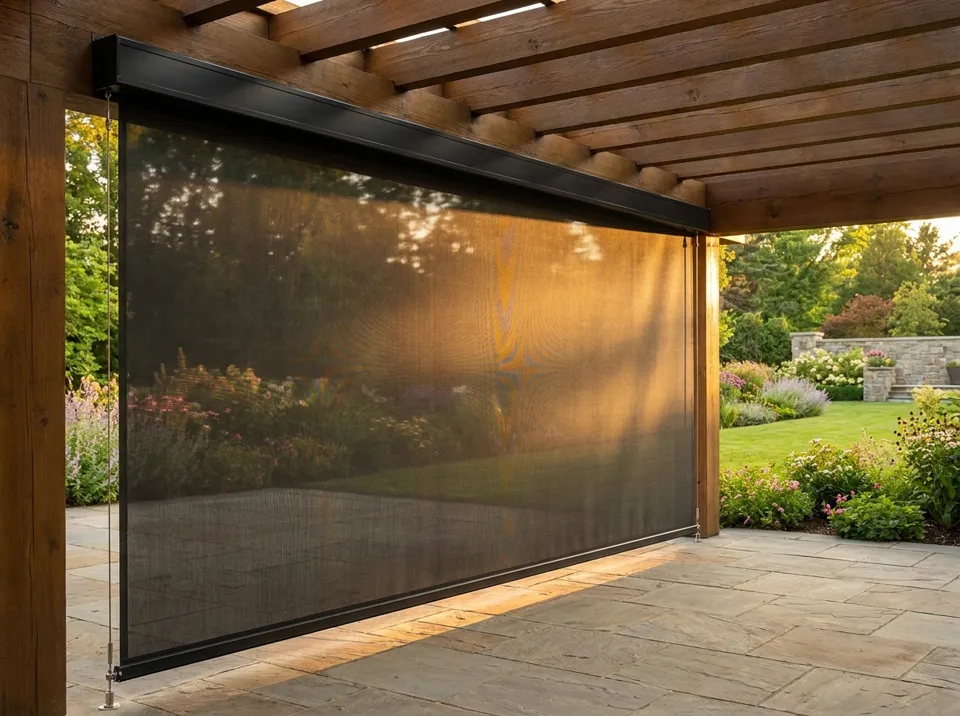
Outdoor shades in Bonney Lake, WA live a harder life than any interior shade in the house. Lake Tapps winds funnel down the hill, Cascade foothill storms hit the west-facing decks by October, and a low afternoon sun burns patio furniture from May through September. This 2026 guide covers the two outdoor systems that actually hold up here — steel wire guided roller shades and zipper track roller shades — plus fabric, wind, and motorization decisions that decide whether the shade survives more than one season.
TL;DR
- Zipper track shades are the best pick for windy Bonney Lake and Lake Tapps decks in 2026.
- Steel wire guided shades are the value pick for sheltered patios and covered porches.
- Openness 3-5% fabric cuts glare and UV while keeping the lake view.
- Self-measure fails outdoors: mount structure, sun angle, and wind exposure all change the order.
- Rainier Blinds measures on site, has your outdoor shades custom-made to your measurements, and installs with our own crew.
Key numbers
Why this matters in Bonney Lake
Bonney Lake sits in a wind pocket. The city sits on a plateau between the White River valley and Lake Tapps, and homes along the lake and the ridgelines take gusts that a sheltered Auburn backyard never sees. A shade that flaps and slaps against its own bottom bar every windy day wears out its fabric edge and its lift system within a couple of seasons. The mount matters even more: outdoor shades hang on posts, fascia boards, and patio cover beams that take weather year-round, and a bracket screwed into a soft 4x4 post is the most common failure point on DIY outdoor shade installs.
Then there is the sun. Summer UV index readings in Western Washington regularly hit 6 to 8 on July and August afternoons, and a west-facing deck in Bonney Lake takes that full load from roughly 3:00 PM onward. Unshaded, the deck furniture fades, the composite decking heats past where bare feet want to go, and the family room behind the slider turns into a greenhouse. A well-chosen outdoor shade fixes all three with one product.
The lake itself adds a third wrinkle. Homes around Lake Tapps face water glare — sun reflecting off the surface doubles the light load on the deck — and morning east-facing porches get glare before coffee. Opacity and fabric openness, not color, are the decisions that make or break the room.
Who this is for
This guide is for Bonney Lake, Lake Tapps, Sumner, and South King County homeowners shading a deck, covered patio, sun-exposed sliding door opening, or open-air seating area. It fits homes backing greenbelt on the west slope, lakefront lots, and newer builds along the Bonney Lake hillside where afternoon sun is the daily problem.
It is not for fully enclosed sunrooms — those are indoor openings and take interior roller or cellular fabric — and it is not for single windows inside the house. If your problem is glare on an interior window instead, start with the indoor comparison in our outdoor shades product guide, which covers both families of shades and where each belongs.
What to look for in outdoor shades for Bonney Lake homes
Steel wire guided vs zipper track systems
The two outdoor systems sold today differ in one thing: how the fabric edge is held.
- Steel wire guided shades run the fabric between a stainless cable on each side. Simple hardware, easy service, and the lowest cost of the two. The fabric can still flex a little off the cable in a gust, which is fine on a sheltered patio and wrong on an exposed lakefront deck.
- Zipper track shades lock the fabric edge into a zipper channel on each side, top to bottom. The fabric cannot blow out of the track, the sides seal, and the system handles wind and light rain far better. This is the system for exposed decks and wind corridors.
The trade is mounting: a zipper track needs a solid frame or post to anchor both side channels, and retrofitting that structure after the fact costs more than choosing it on measure day. Both systems mount to existing posts, fascia, and patio cover beams on most Bonney Lake homes — the measure visit confirms the structure, not a catalog assumption.
Fabric: openness, moisture, and the view
Outdoor shade fabric is a tight mesh weave, sold by openness percentage — the share of open space in the weave. Lower openness blocks more light and glare; higher openness keeps more view and breeze.
- 1-3% openness for a west-facing wall where afternoon glare and UV are the enemy
- 3-5% openness for lake and valley views where the view is half the point
- Darker colors cut glare better and preserve the outward view better than light ones
- Vinyl-coated and solution-dyed fabrics resist the moisture cycle that stiffens indoor fabric outdoors
Avoid natural fiber and indoor-grade fabric on any opening that takes direct weather. The same logic that keeps indoor fabric off an exposed cabana wall applies here: a shade rated for a living room fades and stiffens within one Pacific Northwest wet season.
Operation: cordless, crank, and motorized
The 2026 child- and pet-safety baseline applies outdoors too — a dangling pull cord on a deck used by kids is a hazard, not a convenience. Cordless spring lift works on small openings. Crank operation covers wide spans without chains. Battery motorized lift earns its cost on tall and wide openings, on second-story deck walls, and on any shade you drop at dusk from inside the house. Battery motors recharge roughly every 6 to 12 months depending on cycle count, and the installing crew sets the travel limits so the bottom rail clears the deck surface.
Hardwired motors suit a new deck build where electrical is already being run — running a circuit to an existing deck after the fact is rarely worth it, which is why battery is the common outdoor pick in 2026.
Size and mount on real structure
Deck and patio openings are wider than windows, and the mount surface decides everything. Posts and beams are the strong points; vinyl and aluminum siding between studs is not. The measuring rule: three width and three height readings, plus a check of every mounting surface — fascia, post, beam — for solid backing. Out-of-plumb posts are common on older deck builds, and a shade ordered to a plumb assumption binds in its track within a year.
Top picks for Bonney Lake and South King County
The wind pick: zipper track outdoor shades
The sealed pick. The fabric rides in a zipper channel on both sides, so wind gusts cannot blow it out and the sides seal against driving rain. Buy for exposed lakefront and hillside decks, wind corridors, and any west-facing opening that takes the afternoon weather head-on. Custom-made to your measurements after an on-site measure — post spacing and deck height are numbers a catalog cannot guess.
The value pick: steel wire guided shades
The everyday pick. Cable-guided fabric on both sides, clean lines, and the easiest retrofit onto existing posts and fascia. Buy for sheltered patios, covered porches, and decks under a roof overhang where the wind does not hit the fabric square. Skip it on fully exposed openings in 2026 — the fabric flex is what wears it out.
The glare pick: sunscreen roller shades
The view pick. A 3-5% openness screen fabric keeps the Lake Tapps view and the breeze while cutting glare and UV on the seating area. Buy for decks where the view is the point and comfort is the problem. Pair with a blackout or room-darkening shade inside the house on the same wall where sleep matters.
The access pick: motorized outdoor shades
The set-and-forget pick. Battery motors drop the shade at sunset and raise it at bedtime without walking outside, paired with a remote or phone app. Consider on tall or wide openings and any shade you operate daily; budget the 6-to-12-month recharge cadence into the routine.
What to avoid
Indoor-rated fabric outdoors
Indoor roller fabric outdoors is a one-season product west of the Cascades. Rain, UV, and mildew cycle stiffens and fades it within a year. Ask specifically for outdoor-rated fabric before the order sheet is signed.
Shades mounted to siding between studs
Siding and sheathing are not structural. A shade bracket loaded into siding pulls out or flexes, and the fabric starts dragging within weeks. Mount to posts, fascia, or blocking installed at the measure visit.
Guessing the wind exposure
A system that handles a sheltered Kent backyard fails on a Lake Tapps ridge. The honest answer comes from standing on the deck, checking the deck's orientation, and matching the system to it — not from the cheapest option on a website. Self-measure orders placed online rarely returnable, and outdoor shades expose every error across a full season.
Verdict comparison
| Option | Best for | Key detail | Verdict |
|---|---|---|---|
| Zipper track shades | Exposed decks, wind corridors | Fabric locked in side channels | Buy |
| Steel wire guided shades | Sheltered patios, covered porches | Cable-guided, easy retrofit | Buy |
| Sunscreen roller shades | Lake and valley views | 3-5% openness fabric | Buy |
| Motorized outdoor shades | Tall or daily-use openings | Battery recharge 6-12 mo | Consider |
| Indoor fabric outdoors | None in practice | Fades within one wet season | Skip |
How local measure, custom-make, and install works
We bring fabric samples to your deck so you can judge openness and color in your own afternoon light, not a showroom's. Your outdoor shades are custom-made to your measurements, and our local crew handles measuring and installation.
- Consult and measure: on-site — deck orientation and sun window, post and fascia structure, opening width and height at three points, and wind exposure judged on the deck itself.
- Quote on the spot: real pricing before we leave, covering every opening in the project, including track hardware and any motorization.
- Custom-made by the supplier: fabric and track built to your measurements, typically arriving 2-4 weeks after the order is confirmed.
- Install: usually one visit. Tracks plumbed, travel limits set on motors, and the wind seal checked before the crew leaves.
Coverage and scheduling for Bonney Lake jobs sit on the Bonney Lake service area page, and neighboring Lake Tapps and Sumner coverage sits on the Sumner service area page. The full measure-and-install range, indoor and outdoor, is on the custom window treatments services page.
FAQ
What are the best outdoor shades for Bonney Lake, WA in 2026?
How much wind can outdoor shades handle?
Do outdoor shades block the view of Lake Tapps?
Can outdoor shades be motorized?
How long do outdoor shades last in Western Washington?
Do outdoor shades need a permit in Bonney Lake?
How much do outdoor shades cost in Bonney Lake, WA?
How long does it take to get custom outdoor shades?
One last thing
The detail most homeowners miss is the retract habit. An outdoor shade left down through a windstorm takes more wear in one week than one dropped and raised daily takes in a year. Before you sign the order, ask the measuring crew two things in writing: which system matches your deck's actual wind exposure — zipper track or steel wire — and where the shade's fully-open stack sits relative to your sightline to the lake. Then use the shade in season and retract it in the off-season; the fabric you protect in November is the fabric that still looks new in June 2027.