
Consultations are free within 60 driving miles of Auburn. Farther projects are considered individually; any consultation or travel fee is quoted before booking and credited toward your order if you proceed.
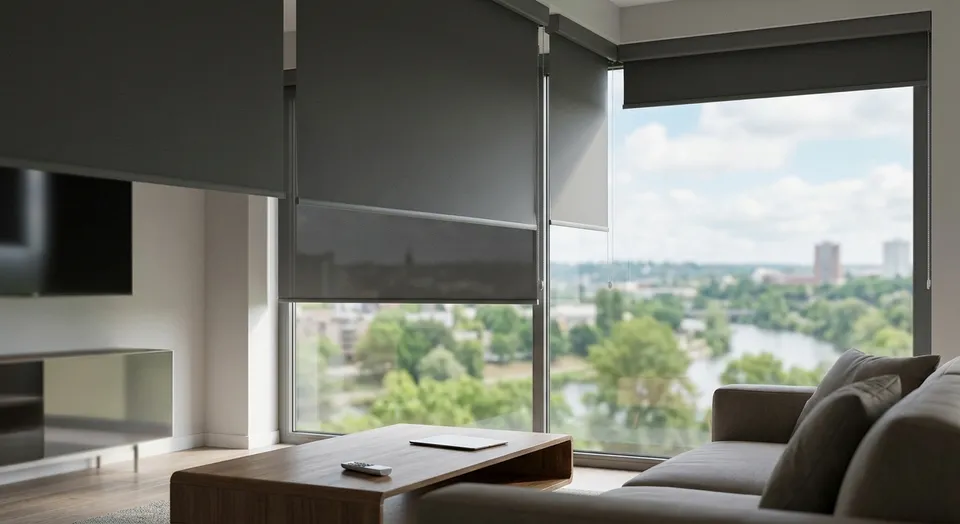
Choosing motorized shades for a Tukwila condo starts with the windows in your own unit: when the sun reaches them, how close neighboring windows are, and where the shades can be mounted. A living room with afternoon glare may need a different fabric from a bedroom facing another building. Motorization makes adjustment convenient, but the fabric, fit, and building requirements still determine whether the finished shades work for you.
Start with a room-by-room checklist
Before choosing a style, note which windows create glare, which need evening privacy, and which are difficult to reach. Take photos of handles, trim, and nearby doors. If you already have a smart-home system, write down the devices you use rather than assuming every motor will connect to it.
- Living room: identify when glare reaches your seating area or television and whether preserving the view matters.
- Bedroom: decide how much light you want to block and discuss light gaps around the shade.
- Home office: check reflections on your monitor during the hours you actually work.
- Balcony door: leave room for the handle, door movement, and your normal walking path.
Compare the fabric before choosing the controls
Roller shades are a straightforward starting point for a clean appearance. Light-filtering fabric softens daylight, while blackout fabric is intended for rooms where stronger light blocking matters. Blackout fabric alone does not guarantee a completely dark room: the mounting arrangement and gaps at the sides also need attention.
Solar-screen fabrics are another option to discuss when daytime glare and the view are priorities. Do not choose a solar fabric on the assumption that it provides the evening privacy you need. Review the sample against your actual window and ask whether a privacy fabric or an additional covering would be more suitable.
Cellular shades offer a different look, with a honeycomb construction and light-filtering or room-darkening options. Zebra shades use alternating sheer and solid bands for adjustable light control. Compare fabric samples in the room rather than choosing solely from an online photo. Our indoor shade collection shows the styles available, and our roller versus cellular guide explains the main tradeoffs.
Check building requirements before finalizing the design
Condo requirements vary by building. Ask your association or property manager whether there are restrictions on the color visible from outside, exposed hardware, attachment points, or changes near the window frame. If you rent, confirm the permitted installation with your landlord as well.
A battery-powered motor does not automatically make an installation approved or damage-free. Brackets still need an appropriate mounting surface. Bring any written requirements to the consultation so the proposed fabric and mounting arrangement can be checked against them before you proceed.
Plan power and charging access
Discuss the power options available for the exact shade and window size you choose. For a battery-powered option, find out how charging works and whether you can comfortably reach the charging connection after installation. A window above furniture or a stair landing may require a different plan from one at an easy working height.
Ask whether a compatible solar charging option is suitable for the selected motor and the light available at that window. If a wired option is being considered, confirm its availability, power requirements, and any building approvals first. Do not assume one charging interval applies to every installation; shade size, use, and the selected system all affect the maintenance plan.
Separate motorized operation from smart-home control
Decide whether you want simple powered adjustment or integration with a smart-home platform. Before selecting smart controls, confirm the exact motor, compatible devices, and any required controller or network equipment. An existing speaker or app is not enough information to guarantee compatibility.
Rainier Blinds reviews the setup during the consultation. You can start with our smart shade overview, then confirm the equipment needed for your chosen shades. Ask for a demonstration of the available controls and discuss how you will operate the shades if your home network is unavailable.
What should a condo shade quote cover?
A useful quote identifies the shade style, fabric, dimensions, controls, power arrangement, and installation scope. Also discuss building access, appointment requirements, and any furniture that needs moving. For large windows, ask whether a single shade or several sections will give the best fit and day-to-day access.
There is no reliable single price for every condo window. The window sizes, fabric choices, and control options need to be specified first. Rainier Blinds brings samples, measures the windows, and provides a quote for your home. Request an in-home quote to compare options for your Tukwila condo.
Questions to ask at your consultation
- Will this fabric provide the privacy I need when the room lights are on?
- How much space will the shade and brackets take up around the frame?
- Can I reach the charging connection without moving heavy furniture?
- What equipment is required for the controls I want?
- Does the proposed installation match the written requirements from my building?
- What is included in the measured quote, and which options change the price?
The best choice is the one that fits your actual windows and routine. Start with privacy, glare, mounting, and access; then choose the motor and controls that make those shades easy to use.