
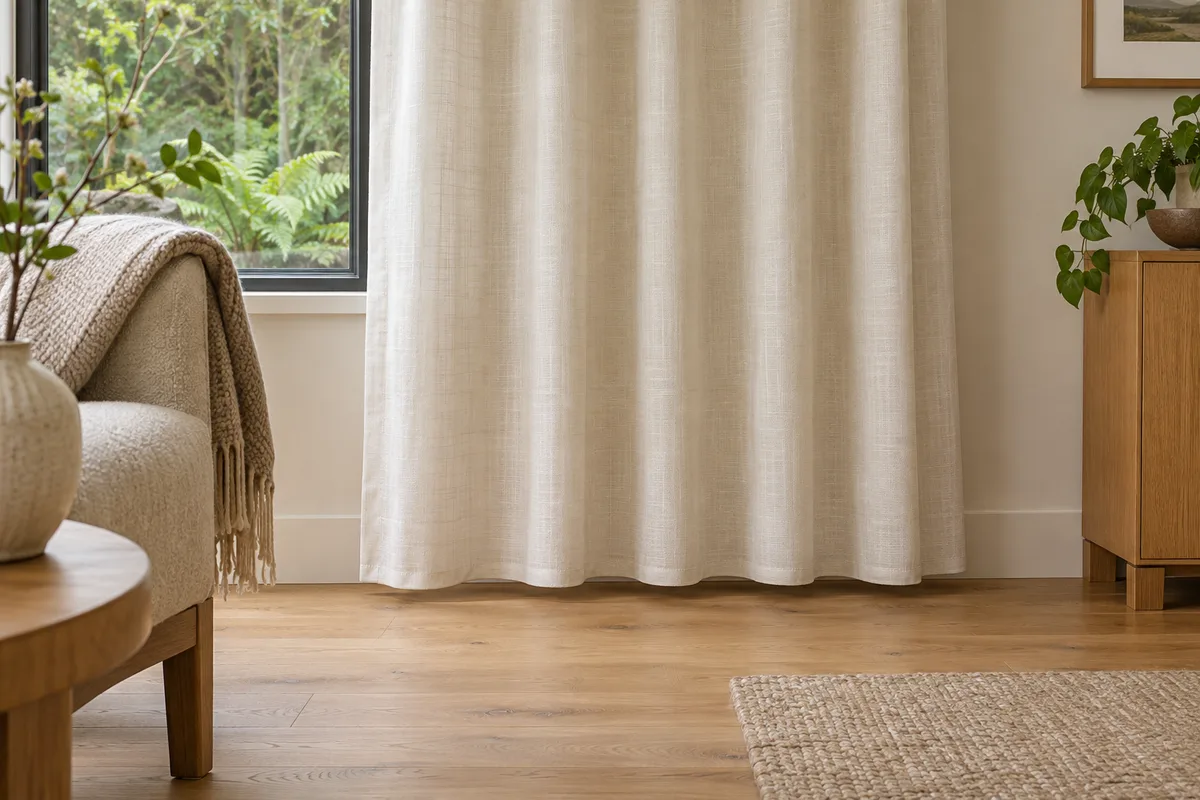
A drapery panel can clear the floor at one end of a window and brush it at the other. That does not automatically mean the panel was made incorrectly. The floor, mounting position, hardware, and fabric all need to be considered together.
If you want a clean floor-length finish, start with how the drapery will move through the room. A narrow gap that looks perfect in one photograph may not work across the full window wall.
For an Auburn or Greater Seattle home, the useful question is not simply “Should the curtains touch the floor?” It is “What finish will look right and work well across this particular floor?”
Quick takeaways
- Decide whether the panels will move every day or mainly stay in place.
- Check the floor along the entire path of the fabric, not just at each end.
- Choose the hardware before finalizing the finished panel length.
- Compare a floating hem with a soft break using your selected fabric.
- Tell the consultant about planned flooring changes before ordering.
Start with the way the panels will be used
Drapery that opens each morning and closes each evening needs to move freely. If the fabric trails across the floor, it can catch on a rug or collect dust as it moves. A decorative panel that stays beside the window has different demands.
Show the consultant the route you use beside the window, especially at a patio door or behind a dining chair. Explain whether the drapery will provide everyday privacy or mainly frame a shade underneath.
For panels you will operate often, we would start by discussing a hem that clears the floor, then compare the appearance with a small amount of contact. For stationary panels, a softer finish may be practical if it stays out of walkways and away from heating equipment.
Compare a float with a soft break
A floating hem hangs above the floor. A break allows some fabric to meet the floor and bend gently. A puddle leaves more fabric resting on the floor. These are visual choices, not interchangeable installation instructions.
The Shade Store's curtain-length guidance explains that a crisp floating line can make an uneven floor more noticeable, while extra length can soften that visual difference. It also notes that puddled fabric is less convenient for panels that move frequently.
That does not make longer drapery the answer to every uneven floor. Fabric resting on the highest part may drag as it travels, while fabric over a lower part may still appear different. Compare the look and the movement together rather than choosing from a photograph alone.
Avoid using a universal number of inches from an online guide as the order measurement. The finished length needs to suit the actual hardware, panel construction, floor, and agreed appearance.
Check the full path of the fabric
A floor can change height between the left, center, and right of a window wall. There may also be a rug, a transition strip, or a different surface where the panels gather when open.
Ask for the floor-to-hardware relationship to be checked at several points across the span and wherever the fabric will travel. If the goal is a floating hem, review the tightest clearance as well as the largest visible gap. A panel that clears the floor when closed should not catch somewhere else when opened.
Keep the rug and furniture layout close to the arrangement you plan to use. Point out a rug that is about to be replaced, rather than letting the current one become an unnoticed part of the fit decision.
The space occupied by open panels matters too. Our guide to drapery stackback covers where gathered fabric sits beside the window. Length and stackback should be checked together so the panels have a usable resting place.
Settle the hardware before the final length
The point where the fabric hangs is not necessarily the ceiling, the top of a decorative rod, or the top edge of the window trim. Carriers, hooks, and the selected heading affect how the finished panel sits beneath its support.
Rainier's drapery options include ceiling-mounted tracks and decorative rods with internal carriers. We confirm the selected fabric and hardware in the quote. Changing the hardware after the panels have been measured can change the relationship between the hem and the floor.
Ask whether any height adjustment is available with the exact system being ordered, and how much. Do not assume a hook can be raised or lowered, or that moving a bracket is an appropriate way to fix a length difference.
If the ceiling and floor are not parallel, discuss the visible tradeoff before ordering. A straight hardware line and an identical gap below every part of the fabric may not both be possible without other work to the room.
Consider fabric and future changes
Fabric behavior matters alongside the measurements. Some fabrics can relax, stretch, or shrink, so ask about the selected fabric and lining rather than treating a sample's appearance as a promise that the finished hem will never move. The manufacturer's care instructions should guide cleaning.
If new carpet, underlay, tile, or wood flooring is planned, tell the consultant before the final measure. A change in the finished floor height can alter the clearance. Confirm whether final measurements should wait until the new surface is complete.
Also point out radiators, baseboard heaters, and floor vents. Follow the equipment manufacturer's clearance requirements. A floor-length look should not mean fabric resting against a heater or blocking access that the room needs.
Review the result before installation ends
Look at the drapery from your usual seat and from the doorway, not only while standing directly beside the hem. Open and close the panels through their full travel and check the area where they gather.
Use these questions for the final review:
- Does the hem match the float or break we agreed on?
- Does the fabric clear the floor and rug where it needs to move?
- Are any visible differences caused by the floor or by the panel position?
- Can the window, door, and nearby furniture still be used normally?
- What adjustment or follow-up is appropriate if something catches?
If one section looks wrong, have it checked before trying to shorten the fabric or change the hardware yourself. A useful review identifies the cause rather than assuming every uneven-looking hem needs the same fix.
Choose the finish in your own room
Rainier Blinds brings samples, takes final measurements, and helps you compare fabric and hardware for your home. Bring a photo of the full window wall and explain whether you prefer a crisp floating hem or a softer finish. You do not need to supply final installation measurements.
Book a drapery consultation to review the options in your space. Consultations are free within 60 driving miles of Auburn, WA, with no obligation to order. Farther-away projects are considered individually, with any consultation fee quoted before booking and credited toward your order if you proceed.