
Our available controls: Rainier Blinds offers Roman and woven wood shades with motorized operation only. Available controls and power options for other products are confirmed at your consultation.
Consultations are free within 60 driving miles of Auburn. Farther projects are considered individually; any consultation or travel fee is quoted before booking and credited toward your order if you proceed.
Kent homes face two different window problems depending on which side of the valley they sit on. Down on the Green River Valley floor, homes fight trapped fog and heat loss from November through March. Up on the East Hill, big builder-grade windows bake rooms with hard afternoon glare by July. This 2026 guide covers every product line that fixes both — roller, cellular, zebra, woven wood, Roman, specialty, outdoor shades, and custom drapery — with picks by window and room, honest drawbacks, and how Rainier Blinds handles custom window treatments from measure to install.
TL;DR
- Cellular shades win Kent's older valley-floor homes on winter heat loss.
- Sunscreen roller shades hold the view and cut East Hill afternoon glare.
- Zebra shades deliver day-to-night light control on a single shade.
- Outdoor shades with a zipper track extend Lake Meridian decks past sunset.
- Rainier Blinds measures on site, prepares a measured quote, and installs with our own crew.
Why this matters
Kent's housing splits the problem cleanly. Downtown, around Kent Station, and across the valley floor, the housing stock skews mid-century and 1970s — aluminum-frame windows that pour heat out all winter. The valley also traps morning fog for weeks at a stretch, so those rooms need insulation against a damp cold more than they need decoration. Up on the East Hill, homes built from the 1990s through the 2000s carry large windows chosen for their views. West-facing glass bakes rooms by mid-afternoon in July and August, and the Puget Sound lowlands still log about 37 inches of rain a year — the same window needs light in the gray season and full coverage in the bright one.
Stock retail shades fail both halves. Big-box programs sell fixed widths and standard drops; Kent's older openings have settled out of square, so a nominal-size shade either binds in the frame or leaves a bright line down one side. Shaped glass — entry transoms, angled windows, skylights under vaulted ceilings — gets skipped entirely by stock programs. A treatment measured on site and custom-made to those measurements is the only option that covers every window in the house, and it is the basis for every pick below.
Who this is for
This guide is for Kent homeowners from the valley floor through East Hill and Panther Lake, plus neighbors in Covington, Renton, and Maple Valley who sit minutes from the Kent border. It fits owners of older homes replacing shades that never fit right, buyers finishing new construction where the builder left windows bare, and anyone who wants one local crew to handle measuring, ordering, and installation instead of coordinating three vendors. Every product line Rainier Blinds sells appears here with a verdict.
What makes the best custom window treatment in Kent
Measured on site, not estimated
Older Kent openings settle. Frames go out of square, sills tilt, and a shade built from a tape-measure guess either binds in the frame or leaves a light gap. Every window gets measured individually before anything is ordered, and shaped windows — arches, trapezoids, skylights — are templated in person so the fabric arrives cut to the actual opening.
Fabric chosen in your own light
We bring samples to your home so you judge weave, texture, and opacity in the room where the shade will hang. A fabric that reads crisp in a showroom reads flat in a north-facing valley-floor room, and only your own light shows that before you commit.
a quote for your selected products
We prepare a written quote for the selected windows and products. Our lowest-priced manual shade starts around $275 for a standard 32×48-inch window, with basic installation included. Other styles, sizes, fabrics, and controls are quoted separately. The written quote confirms the final scope and selections.
Our own crew, not a subcontractor
The people who measure your windows are on the same crew that installs them. Fit problems get caught at the measure visit instead of discovered on install day.
Warranty stated up front
Every order carries a warranty of up to 5 years depending on the package, with the coverage printed on the quote rather than buried in paperwork after the install.
Kent picks at a glance
| Product line | Best for | Standout detail | Verdict |
|---|---|---|---|
| Cellular shades | Heat loss on older glass | Double-cell insulating pocket | Buy |
| Sunscreen roller shades | Glare and view | Openness level tunes the light | Buy |
| Zebra shades | Day-to-night control | Alternating sheer and solid bands | Buy |
| Blackout shades | Bedrooms and shift work | Side channels seal the edges | Buy |
| Roman and woven wood | Texture and living spaces | Soft folds, natural weave | Consider |
| Specialty shades | Arches, trapezoids, skylights | Templated on site | Consider |
| Outdoor shades | Decks and patios | Zipper track holds fabric steady | Buy |
| Custom drapery | Tall windows, layered rooms | Custom widths, blackout lining | Consider |
The picks
1. Cellular shades: best for valley-floor heat loss — Buy
Cellular shades trap insulating air and may help at windows that feel cold. Compare the selected product's thermal data, available controls, and mounting requirements. Follow its safety instructions; specialty operations such as top-down/bottom-up must be confirmed for the selected model.
2. Sunscreen roller shades: best for glare and view — Buy
Sunscreen roller shades filter light while preserving the view out — valley-floor homes keep their street and greenbelt sightlines, and East Hill great rooms keep the sky. The openness level sets the trade: tighter weaves cut more glare, more open weaves hold more view and daylight. Common levels run from 1 to 14 percent openness, and 3 to 5 percent is the working middle for west-facing rooms. Pair one with a blackout roller in the same window when the room needs real dark after sunset. Buy for any window you live with the view through.
3. Zebra shades: best for day-to-night light control — Buy
Zebra shades alternate sheer and opaque bands. Align the bands and the room glows with filtered light; overlap them and the window closes. One shade covers the whole day without swapping products, which suits Kent home offices and street-facing living rooms that change use from morning to night. They also mount in shallower frames than most treatments, which older Kent windows appreciate. The tradeoff: the bands never seal the edges, so true blackout needs a different treatment. Buy where the light changes all day; skip them where you need real dark.
4. Blackout roller and cellular shades: best for bedrooms — Buy
Kent runs on shift schedules — hospital, logistics, and millwork employers all work odd hours — and a bedroom that goes genuinely dark is worth real money to those households. Blackout fabric in a roller or cellular build, with side channels along the frame, closes the light gaps that plain blackout shades leave at the edges. Summer works against you too: sunrises around the June solstice land before 5:30 AM, and upstairs East Hill bedrooms catch them first. Buy for any bedroom where someone sleeps past sunrise.
5. Roman and woven wood shades: best for texture — Consider
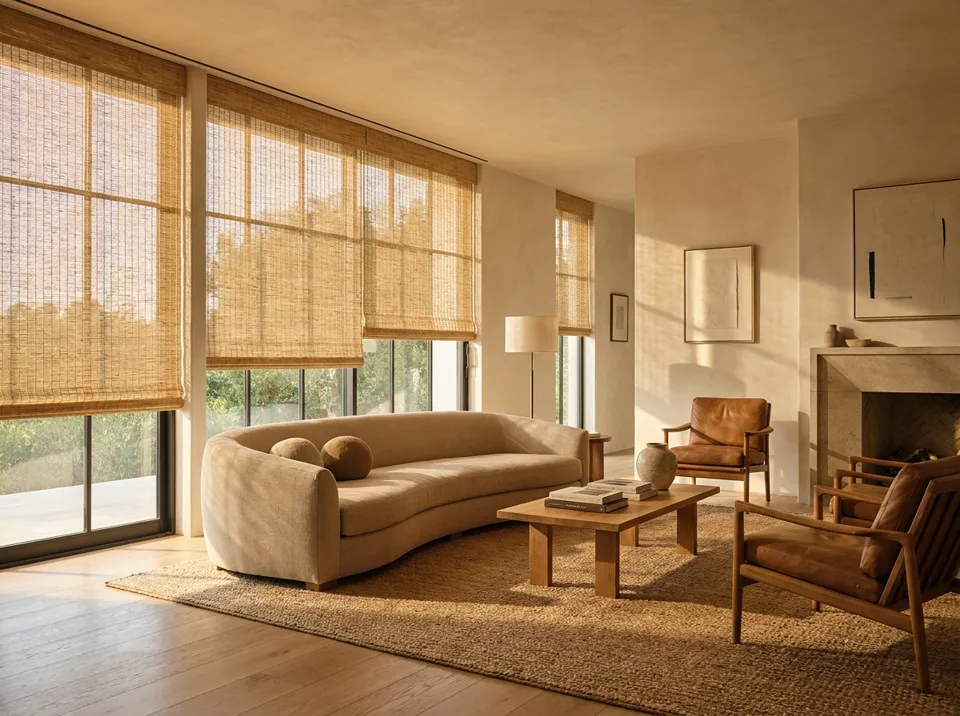
Roman shades fold into soft horizontal stacks, and woven wood shades bring real bamboo, reed, and grass texture into the room. Both add warmth where flat roller fabric reads too spare, and both layer well with drapery panels. The drawbacks are real: they cost more than flat shades, and the raised stack eats several inches of window height when the shade is up, which matters on shorter openings. Consider for living and dining rooms where the look justifies the cost; skip them where stack height would cover half the glass.
6. Specialty shades: arches, trapezoids, and skylights — Consider
Vaulted East Hill ceilings and older Kent homes hide shaped glass that stock programs will not touch: entry transoms, angled gable windows, skylights. Custom shades for those shapes exist — fixed covers, movable shades on curved or angled tracks, motorized skylight shades for glass you cannot reach — but every one is templated in person, costs more than a rectangle, and takes longer to arrive. Consider any shaped window that throws light or heat into a room you use daily; leave a decorative transom bare if it does not bother you.
7. Outdoor shades: best for decks and patios — Buy
Outdoor shades stretch the deck season around Lake Meridian and the Green River neighborhoods, cutting wind-driven rain and evening chill without closing off the yard. Steel-cable guides suit calmer patios; a zipper track locks the fabric edge into the side rail and holds it steady in the wind that funnels down the valley. Motorized lift makes wide covered patios practical instead of a crank workout. Buy for decks you want usable in shoulder season, not just July and August.
8. Custom drapery: best for tall windows and layered rooms — Consider
Custom panels suit two-story entries, tall window walls, and rooms where shades alone read unfinished. Made-to-width panels with blackout lining add serious light blocking over any shade, and they soften rooms that are all hard surfaces. The drawbacks are real: drapery costs more per window than shades and needs more upkeep. Consider it for the rooms you want finished properly; skip it as a whole-house solution.
What to avoid
- Ordering online from nominal measurements. A "36-inch" window in a Kent home built before 1990 is rarely 36 inches anymore. Measure every opening individually.
- One opacity for the whole house. Bedrooms need blackout, living rooms need filtered light, and no single fabric does both well.
- Corded hardware within reach of kids or pets. Cordless or motorized lift is the correct hardware at any reachable height.
- Skipping the template on shaped windows. Curved and angled fabric cannot be trimmed after it arrives; an error is a full remake.
- Any quote that needs a callback. If the price is not real before anyone leaves, the measuring probably is not either.
How local measure and install works
Rainier Blinds runs the same four-step process in Kent that we run across South King County:
- Consult: we talk through the rooms, which way the glass faces, and what each window needs to do.
- Measure with samples in hand: fabric samples come to your home, every window is measured, and shaped glass is templated on site.
- Measured quote: Our lowest-priced manual shade starts around $275 for a standard 32×48-inch window, with basic installation included. Other styles, sizes, fabrics, and controls are quoted separately.
- Production and installation timing depend on the selected fabric, hardware, supplier availability, and project scope. We confirm the current estimate for your order before you plan around a completion date.
Coverage details sit on the Kent service area page.
FAQ
How much do custom window treatments cost in Kent, WA?
What window treatments work best for Kent's Green River Valley fog and cold?
Are custom shades worth it compared to store-bought window coverings?
How long does it take to get custom shades installed in Kent?
Do cellular shades really lower heating bills in Kent?
What is the difference between zebra shades and roller shades?
Can you put shades on skylights and angled windows?
Do you install outdoor shades on decks in Kent?
One last thing
Ask about dual roller shades before you settle on any bedroom or media-room window. Two fabrics — a sunscreen and a blackout — ride on one bracket and one headrail, so the same window switches from view to full dark in one motion, with no second shade and no second install. On street-facing Kent living rooms it answers the oldest complaint in the category: you want the view at noon and privacy at nine.
Book the in-home quote while the afternoon sun is on the west glass — watching where the light lands answers the sunscreen-versus-blackout question faster than any spec sheet.