
Our available controls: Rainier Blinds offers Roman and woven wood shades with motorized operation only. Available controls and power options for other products are confirmed at your consultation.
Consultations are free within 60 driving miles of Auburn. Farther projects are considered individually; any consultation or travel fee is quoted before booking and credited toward your order if you proceed.
Custom window treatments in Redmond, WA start with a measure visit, not a catalog. A local crew measures every opening, the shades are custom-built by an established wholesale supplier to those exact numbers, and the same crew returns to install them. That process — not the fabric label — is what separates a shade that seals, hangs straight, and runs true for years from a stock panel that ripples in the frame. This 2026 guide covers the shade and drapery options that fit Redmond's housing stock, how the city's gray season and low-angle afternoon sun change the fabric decision, what custom work costs, and how measure, order, and install runs from Education Hill to Overlake. Coverage and scheduling for your address sit on the Redmond service area page.
TL;DR
- Custom window treatments in Redmond WA mean measured, supplier-built shades and drapery installed by one local crew.
- Roller shades fit Downtown and Overlake condos; cellular shades insulate older Education Hill glass.
- Redmond's low winter sun makes sunscreen and light-filtering rollers the default for west-facing rooms.
- Your measured quote confirms the selected product, fabric, controls, and installation scope.
- Production and installation timing depend on the selected fabric, hardware, supplier availability, and project scope. We confirm the current estimate for your order before you plan around a completion date.
Why this matters
Redmond homes deal with two light problems, and they peak in opposite seasons. From October through March the sky sits low and gray, and the sun that does appear hangs close to the horizon in the southwest. In a west- or south-facing room that means direct glare at eye level late in the afternoon — across a kitchen counter, a work-from-home monitor, a television. In June the problem flips: sunrise lands before 5:30 AM and daylight runs past 9:00 PM, so bedrooms need real dark, not a dimmer.
The second problem is the housing stock. Education Hill's mid-century ramblers still run original or early double-pane glass that reads cold from November through March. Downtown and Overlake condos and townhomes pair oversized sliders with floor-to-ceiling windows. Newer View Ridge builds stack tall great-room windows that no off-the-shelf panel reaches. Stock treatments fail all three for the same reason: they are built to a chart, not to the window.
Custom is the answer to both, and custom is a process. Someone stands in front of the window with a tape, records three widths and three heights, checks casing depth, notes cranks and sensors, and orders to the tightest usable number. The fabric and hardware are built for your home to those measurements, and the crew that took them installs the result. Get the process right and the fabric choice becomes straightforward. The sections below make both decisions explicit.
Who this is for
This guide is for Redmond homeowners and condo owners weighing custom window treatments in 2026: Education Hill and View Ridge households replacing worn window coverings, Overlake and Downtown buyers furnishing a townhome or condo with sliders and glass walls, and anyone in the city or on the surrounding Eastside who wants measure-and-install handled by one accountable local crew. It also fits buyers planning a remodel or new build who know the window count but have not picked fabrics, and commuters who want shades that run on a schedule without being touched.
It is not a DIY hanging guide. If the plan is to order cut-to-size panels online and install them yourself, this page will not help; the whole point here is the measure and the fit.
What to look for in custom window treatments for Redmond homes
Decide the room's light job first
Choose fabric by the room's job: solar screen for glare and a daytime view, light-filtering fabric for softer daylight, or blackout fabric for darkening. Compare actual samples and privacy after dark; blackout fabric still needs suitable edge coverage.
Insulation on older windows
Cellular shades trap air in a honeycomb structure, so they insulate while they shade — the right pick on Education Hill-era single- or double-pane glass, where the window surface itself runs cold from November through March. Double-cell fabric adds more insulation at the cost of a deeper stack. On newer builds with modern glass the insulation gain is small, and a flat roller usually wins on looks.
One window, two jobs
Some rooms genuinely need both behaviors on the same window: a bright daytime view and a dark evening. Two products solve it. Zebra shades alternate sheer and opaque bands on one roller and shift between them with a pull. Day/night dual shades stack a light-filtering layer with a room-darkening layer in one headrail. Zebra suits living rooms and offices that transition through the day; dual suits primary bedrooms. Check casing depth before ordering either — two layers need more stack room than one.
Specialty shapes
Redmond's newer builds and remodeled homes produce the windows stock catalogs skip: arched tops, trapezoid windows that follow a vaulted roofline, skylights. All three are built-to-measure products — arched and trapezoid shades cut to the exact geometry, skylight shades with side rails that hold the fabric against the slope. A phone-photo measurement does not carry enough information for any of them; they are the clearest case for an on-site measure.
Motorized lift and cordless safety
Cordless controls avoid exposed operating pull cords. Follow the product safety instructions and keep beds, furniture, and other climbing objects away from windows. Motorization can help on tall or obstructed windows. Recharge intervals depend on the selected motor, battery, shade size, use, and conditions. We confirm the charging method and access before ordering. App controls, scheduling, solar charging, hardwiring, or other power options must be confirmed for the exact product.
Fit is the whole product
A custom shade is judged on the millimeter. A frame a quarter inch out of square leaves a light wedge an inside-mount shade cannot close; a stack that ignores a crank handle fouls the hardware. The measure visit records three widths and three heights per window, orders to the tightest usable number, and chooses inside or outside mount based on the real frame. That is also why self-measured online orders disappoint: fabric cut to uploaded numbers is rarely returnable, and the error only shows on install day.
Top picks for Redmond homes
The Eastside default: roller shades
Roller shades do the most jobs across Redmond housing in one product family — sunscreen for sliders and view windows, light-filtering for common rooms, blackout for bedrooms — with a clean flat face that suits modern Overlake and Downtown interiors. Buy as the default for standard rectangular windows.
The energy pick: cellular shades
Cellular shades insulate older glass while they shade, and they earn their keep from November through March on Education Hill-era windows. Buy for bedrooms and main-floor rooms on older glass; skip on new construction where the window already performs.
The flexible pick: zebra shades
Zebra shades move between filtered light and near-full privacy with one pull, no second product on the wall. Buy for living rooms, offices, and dining rooms that transition through the day; skip where true darkness is the requirement.
The finished-room pick: roman shades and drapery
Roman shades fold into soft horizontal pleats, and paired drapery panels frame the window and finish the room. Buy for primary suites, dining rooms, and any space where a bare roller reads unfinished.
The scheduling pick: motorized shades
Motorization can make tall or obstructed windows easier to adjust. Confirm compatible remotes, app features, and scheduling before ordering. Recharge intervals depend on the selected motor, battery, shade size, use, and conditions. We confirm the charging method and access before ordering.
The outdoor pick: patio and deck shades
Outdoor shades extend the deck season — steel-wire-guided fabric for open patios, zipper-track shades that seal the sides against wind. Buy for west-facing decks that go unused in late-afternoon sun.
What to avoid
Stock sizes on custom problems. A 36-inch panel on a 35.5-inch window leaves a gap that never closes; a measured order seals. Self-measure kits. Custom fabric cut to uploaded numbers is rarely returnable, and out-of-square frames hide their error until install day. One fabric doing two jobs. A blackout shade in a day room reads cave-like by noon; name the light job and buy to it. Bare inside mounts in sleep rooms. Light travels around the fabric, not through it — bedrooms need an outside-mount overlap or side channels to be genuinely dark.
Verdict comparison
| Option | Best for | Key detail | Verdict |
|---|---|---|---|
| Roller shades | Most standard windows | Sunscreen, light-filtering, blackout in one family | Buy |
| Cellular shades | Older, colder glass | Insulates while it shades | Buy |
| Zebra shades | Rooms that switch jobs | Sheer and opaque bands, one roller | Buy |
| Roman shades and drapery | Formal rooms | Soft pleats, finished look | Buy |
| Motorized shades | Tall, high, scheduled windows | Charging requirements vary | Consider |
| Outdoor shades | Decks and patios | Steel wire or zipper track | Buy |
How measure, custom-make, and install works
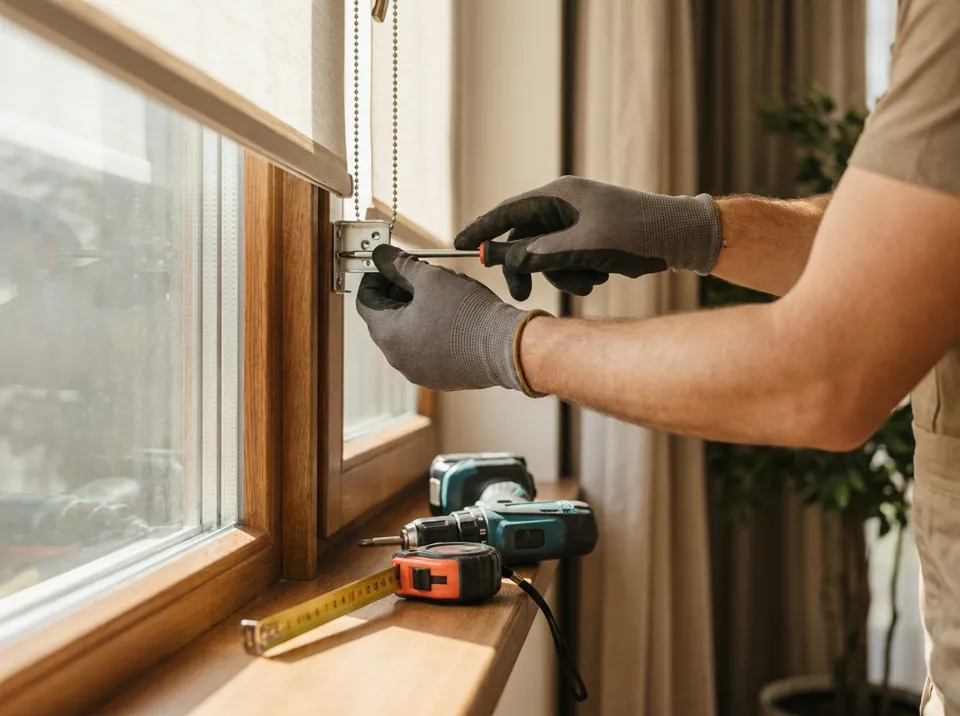
We bring fabric samples to your home and help you choose the weave, texture, and finish in your own light. Your shades are custom-made to your measurements, and our local crew handles measuring and installation.
- Consult and measure: on-site, room by room — the light job of each room, three widths and three heights per window, casing depth, every crank and sensor noted.
- Measured quote: real pricing before you place your order, on every window in the project. Your measured quote confirms the selected product, fabric, controls, and installation scope.
- Production and installation timing depend on the selected fabric, hardware, supplier availability, and project scope. We confirm the current estimate for your order before you plan around a completion date.
- Installation: our team checks mounting and operation, sets motor travel limits where applicable, and shows you the controls. The number and timing of visits depend on the project.
See the custom window treatments services page for our available products. A measuring visit helps us confirm fit and selections, and the written quote records the agreed scope. Service life depends on the product, use, exposure, and care.
FAQ
What are the best custom window treatments for Redmond, WA homes in 2026?
How much do custom window treatments cost in Redmond, WA?
How long does it take to get custom shades installed in Redmond?
What shades work best for Redmond's dark winters and low sun?
Can you motorize shades in a Redmond condo or townhome?
What window treatments insulate older Redmond windows?
Do you make the shades yourselves?
Which areas around Redmond do you serve?
One last thing
Book the measure visit for a late afternoon in the gray season if you can. Watching the low winter sun cross the room — where it lands, what it glares off, which frame it leaks around — answers more questions in twenty minutes than a swatch ring does in an hour. Then ask the crew to confirm the light job of every room in writing before the order sheet is signed. That one line is what keeps a bright kitchen from turning cave-dark and a bedroom from glowing at dawn.