
Our available controls: Rainier Blinds offers Roman and woven wood shades with motorized operation only. All other shade styles are available with manual, motorized, or smart control. Your consultation confirms the controls and power options for your product.
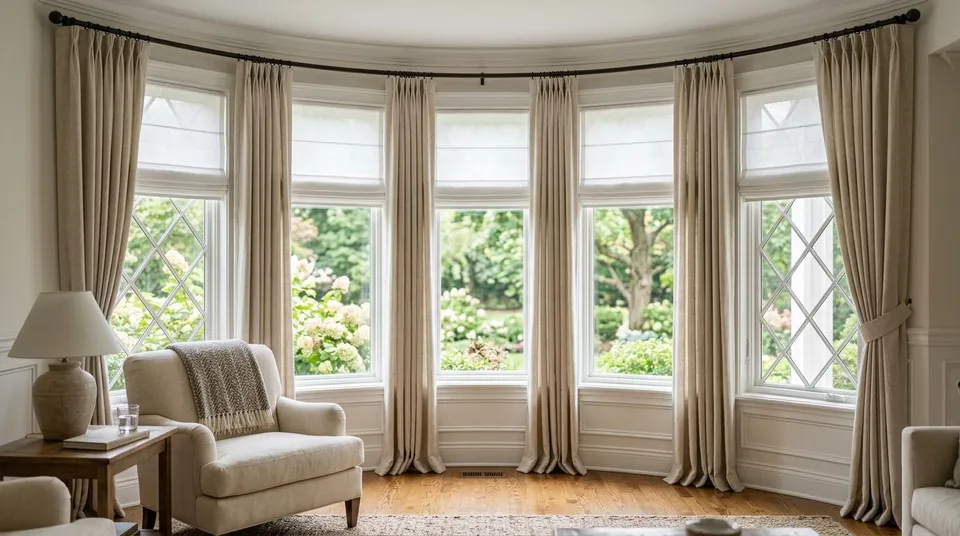
Bow window treatments are custom-measured shades and drapery installed across the curved, multi-pane structure of a bow window, with the goal of controlling light and privacy in each angled pane without hiding the window's panoramic shape. A bow window typically has four or five flat panes set at shallow angles to form a gentle curve, which means a single flat shade almost never fits the whole opening the way it would on a standard picture window. Homeowners in Auburn, Bellevue, Tacoma, and across the Greater Seattle Area deal with this exact problem: one continuous treatment or several individual shades, and how to keep the seams from looking sloppy.
- Bow windows need per-pane shades, not one flat treatment, because each pane sits at a different angle.
- Cellular and roller shades are the two most common picks for bow windows in 2026 because they mount cleanly on angled frames.
- Motorized operation solves the reach problem on center panes that sit behind furniture or window seats.
- Rainier Blinds measures each pane separately during a free in-home consultation, then has each shade custom-made to those measurements.
- Layering drapery over the outer panes frames the curve without covering the view from the center pane.
Why window treatments for bow windows matter for this segment
A bow window is an investment feature. It adds floor space, floods a room with light from three or more directions, and usually anchors a living room, dining room, or breakfast nook. That also makes it the hardest window in the house to cover well.
Standard blinds and shades are built and packaged for rectangular, single-pane openings. A bow window forces a choice on day one: order separate shades for each pane, sized and mounted individually, or treat the whole bow as one continuous run using flexible track hardware. Get this decision wrong and you end up with light gaps at the seams, shades that don't retract evenly, or a curve that visually disappears behind bulky drapery. This is a mounting and measuring problem first, and a fabric problem second.
Measure every pane on its own
Bow windows almost never have identical pane widths, even when they look symmetrical from across the room. Framing settles, older homes shift, and factory tolerances vary pane to pane.
- Measure each pane's width at the top, middle, and bottom, since angled panes rarely measure the same at all three points.
- Record the depth of the frame at each pane if you're considering an inside mount, since bow window frames are often shallower at the angled sections.
- Note the angle between panes; anything sharper than the standard 20 to 45 degree bow angle changes hardware options.
- Check for obstructions like window seats, radiators, or built-in shelving that limit how low a shade can hang.
- If you're not confident measuring three points per pane across four or five panes, a measuring windows for custom blinds walkthrough covers the basics before you call anyone out.
Decide between per-pane shades and one continuous treatment
This is the single biggest decision for bow window treatments, and it affects every choice after it.
- Per-pane shades give you independent light control on each section, which matters if the bow faces east and gets direct morning sun on only two of the four panes.
- Continuous curved-track drapery covers the whole bow in one motion but sacrifices the ability to open just one pane.
- Mixing the two, shades on each pane with drapery panels on the outer two flanking the bow, keeps the center view open while framing the curve.
- Cost and complexity both rise with the continuous-track approach because the hardware itself is custom-bent to the bow's angle.
Pick a shade type that handles angled mounts
Not every shade style mounts cleanly on the narrow, angled frames a bow window creates.
- Cellular shades compress into a slim stack, which matters when pane widths run narrow on the angled sections.
- Roller shades mount flush and stay flat against the glass, a good fit when you want an unobstructed view through each pane.
- Zebra shades (dual-layer light-filtering and privacy stripes) work well on bow windows facing the street, since you can adjust opacity pane by pane.
- Roman shades add texture and work on the center pane of a bow, but stack height can be an issue on shallow-depth angled panes.
- Woven wood roman shades bring a textured, natural look and are worth considering for a bow window in a dining room or breakfast nook.
Choose manual, motorized, or smart operation
Bow windows put center panes in awkward reach, especially behind a window seat or built-in bench.
- Manual shades cost less to operate long-term and work fine on outer panes you can reach directly.
- Motorized shades solve the reach problem on the center pane and any pane blocked by furniture, and they let you operate all panes from one remote.
- Smart shades add app and voice control (Google Home, Alexa) so multiple panes can be scheduled to open and close together.
- A mixed setup, manual on the two side panes and motorized on the center, is common and keeps upfront cost lower than motorizing the whole bow.
Coordinate drapery to frame the curve
Drapery adds softness around a bow window without competing with the shape.
- Mount drapery hardware outside the bow's outer edges, not on the angled panes themselves, so panels stack back cleanly when open.
- Use a single traverse rod across the front face of the bow rather than curved track unless you want full coverage across all panes.
- Match drapery fabric weight to the room; heavier fabric in a formal dining room, lighter linen-look fabric in a sunroom-adjacent living room.
- Keep drapery panels a few inches shorter than full floor length if the bow window seat sits below the sill, so panels don't bunch on the cushion.
Check mount type against your frame depth
Angled bow panes often have shallower frame depth than the flat wall sections around them.
- Inside mount needs at least 2 to 2.5 inches of clear frame depth per pane, which some older bow windows don't have on the angled sections.
- Outside mount solves shallow-frame problems but requires enough flat wall space between the bow's edge and adjacent trim.
- A mixed mount, inside on the wider center pane and outside on the narrower angled panes, is a common workaround.
Get your bow window measured right
Free in-home consultation, real pricing on the spot.
Comparing shade options for bow windows
| Option | Best for | Key limitation |
|---|---|---|
| Roller shades | Clean, flat look on each pane, unobstructed views | Less insulating than cellular shades |
| Cellular shades | Narrow angled panes, energy efficiency in Pacific Northwest winters | Bulkier stack on very wide center panes |
| Zebra shades | Adjustable privacy on street-facing bows | Not ideal for full blackout in bedrooms |
| Roman shades | Textured, formal look in dining rooms | Can be tight on shallow angled-pane depth |
| Drapery (rod or track) | Framing the whole bow, softening a formal room | Doesn't cover individual panes for privacy alone |
The verdict for most bow window installs in 2026: cellular or roller shades on each pane, with drapery reserved for framing rather than daily light control, because per-pane operation solves the uneven-angle problem drapery alone can't.
Common mistakes homeowners make with bow window treatments
- Ordering one flat shade for the whole bow. Flat hardware doesn't sit against angled glass and leaves light gaps at every seam.
- Measuring only the center pane and assuming the outer panes match. Bow window panes are rarely identical widths, especially in homes built before 2000.
- Choosing bulky drapery as the only treatment. Heavy drapery alone blocks the view a bow window is designed to showcase.
- Skipping motorization on the center pane. A window seat or built-in bench under the center pane makes manual cords impossible to reach without stepping on furniture.
- Mounting hardware before confirming frame depth per pane. Shallow angled sections often can't take the same inside-mount bracket used on the flat wall sections.
A related layout problem shows up on corner window treatments, where two flat windows meet at an angle instead of a curved bow; the per-pane measuring logic is nearly identical.
FAQ
What is the best window treatment for a bow window?
Cellular or roller shades mounted individually on each pane are the best fit for most bow windows in 2026, since they handle narrow angled sections better than one continuous flat treatment. Drapery works well as a framing layer over the outer panes but shouldn't replace per-pane shades for daily light control.
Do bow windows need separate shades for each pane?
Yes, in almost every case. Bow window panes sit at different angles and often measure slightly differently pane to pane, so one flat shade rarely fits the curve cleanly.
Can you motorize shades on a bow window?
Yes, and it solves the most common bow window problem: reaching the center pane when it sits behind a window seat or built-in bench. Motorized shades can be grouped to one remote so all panes operate together or independently.
How much does it cost to cover a bow window with custom shades?
Cost depends on the number of panes, the shade type chosen, and whether panes are motorized. A free in-home consultation is the only way to get an accurate price since bow window pane counts and widths vary house to house.
Is drapery or shades better for a bow window?
Shades give you per-pane light and privacy control, while drapery frames the curve and softens the room without blocking any single view. Most bow windows do better with both: shades for daily control, drapery for the outer panes only.
What mount type works on an angled bow window pane?
Inside mount needs at least 2 to 2.5 inches of clear frame depth per pane, which many older bow windows lack on the angled sections. Outside mount is the common workaround when frame depth runs shallow.
Do zebra shades work on bow windows?
Yes, zebra shades work well on street-facing bow windows because the dual-layer fabric lets you adjust opacity pane by pane without full blackout.
How long does it take to install shades on a bow window?
Installation time depends on the pane count and mount type chosen at the consultation. Multi-pane bow windows generally take longer than a single flat window because each pane is measured and mounted individually.
One last thing
The detail most homeowners miss until installation day: a bow window's center pane is almost always the widest, which means it's the one most likely to need motorization simply because it sits furthest from either side wall. Plan the motorized budget around that one pane first, then decide manual versus motorized for the rest.