
Our available controls: Rainier Blinds offers Roman and woven wood shades with motorized operation only. All other shade styles are available with manual, motorized, or smart control. Your consultation confirms the controls and power options for your product.
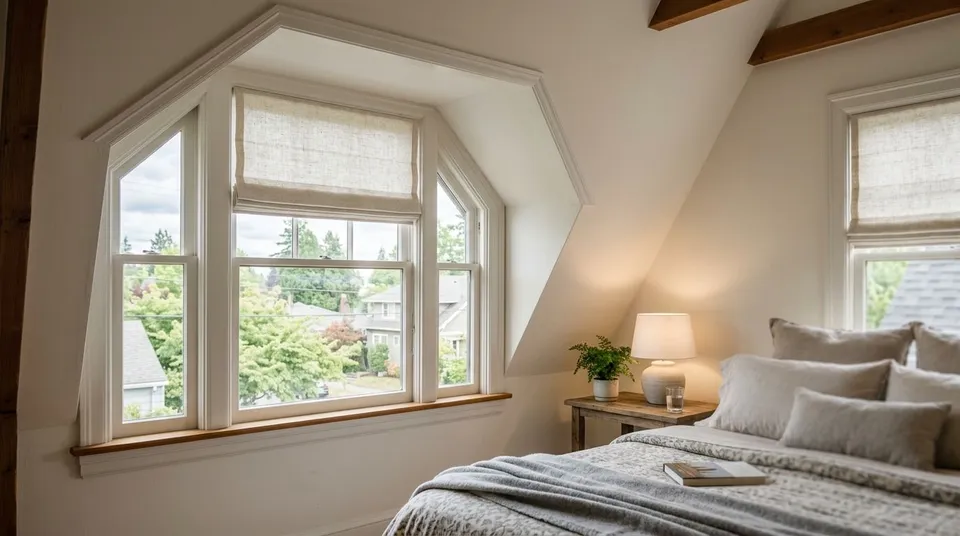
Custom shades for dormer windows are shades cut and mounted to fit the shallow depth, angled trim, and irregular shapes that come with a dormer, not the flat, standard-depth openings most stock shades are built for. A dormer window sits recessed into a sloped roofline, often narrower at the top than the bottom, and it usually gets reached by climbing onto a bed frame or standing on a stairwell landing rather than walking straight up to it.
- Custom shades for dormer windows solve depth and shape problems a stock size can't; cellular and roller shades fit most rectangular dormers in 2026.
- Trapezoid-cut and skylight shades are built for angled dormer glass; a rectangular shade off the shelf will not cover a peaked or sloped opening.
- Motorized and battery-powered shades solve the reach problem on dormer glass set above a bed, stairwell, or vaulted nook.
- Rainier Blinds measures and installs custom shades for dormer windows across the Greater Seattle Area with its own crew, not a subcontractor.
Why dormer windows need custom shades
A dormer window is not a scaled-down version of a standard wall window. The frame depth is often shallower because the window sits at the edge of the roofline instead of inside a full wall cavity, which means the mounting surface a standard headrail needs isn't always there. Shape is the second problem: dormer glass frequently narrows toward a peak (trapezoid), curves at the top (arched), or sits flush into the sloped ceiling itself, so a rectangular shade cut to the widest point leaves gaps at the narrow end.
Attic rooms behind a dormer also run hotter in summer and colder in winter than the rest of the house because there's less wall and roof buffer between the glass and the outside air. That's why fabric choice and cellular construction matter more here than on a ground-floor window. Add in the fact that many dormer windows sit above a bed, over a stairwell, or set into a vaulted ceiling, and daily cord operation stops being practical fast.
Measure your dormer window frame depth first
Before picking a shade type, get accurate numbers on the opening itself.
- Measure width at three points: top, middle, and bottom, since trapezoid and arched frames narrow toward the peak
- Measure the depth of the opening from the glass face to the front edge of the trim
- Note whether the sill sits flush with the wall or drops back under a sloped ceiling plane
- Record the widest point of an arched or angled top if the window isn't a simple rectangle
- Check for obstructions: cranks, screens, or low headroom that limits where hardware can sit
Identify your dormer window's actual shape
Dormer glass comes in a handful of repeatable shapes, and the shape decides which shade category will work.
- Rectangular dormer glass, the most common, still needs a custom-cut size rather than a stock width
- Trapezoid dormer glass, wider at the sill and narrower at the peak
- Arched dormer glass, a rounded top set into a gable
- Skylight-style dormer glass, mounted into the sloped ceiling plane rather than a vertical wall
Choose a shade type built for that shape
Once the shape is confirmed, match it to a product built to hold that geometry without sagging or gapping. This is also the point where a free in-home consultation from a company like Rainier Blinds catches shape issues a DIY tape measure will miss, especially on angled glass.
- Roller shades for flat, rectangular dormer glass where you want a clean, low-profile line against the trim
- Cellular shades for attic bedrooms where the air pocket built into the shade cuts down on heat transfer through a less-insulated sloped wall
- Trapezoid-cut shades for gable-shaped dormer glass that narrows toward the peak, custom-cut to the angle rather than trimmed after the fact
- Skylight shades for dormer glass set into the ceiling itself, built to resist gravity and stay in place at an angle
- Roman or woven wood shades for a dormer nook you want to show off rather than hide behind a bulky stack
Decide between manual, motorized, and smart control
Operation type matters more on a dormer than on a standard window because reach is the real constraint, not looks.
- Manual shades with a cord or wand cost less to operate day to day but require reaching the window each time, which is a problem on skylight-style glass overhead
- Motorized shades lift and lower on a remote or app, the practical choice for a window set above a bed or over a stairwell landing
- Smart shades pair with a schedule so a dormer facing morning sun closes before the room heats up rather than after
- Battery-powered motorized shades work well for retrofit dormer windows since they skip pulling wire through a finished attic wall
If a shade needs a pole or a ladder to reach it every day, it's the wrong operation type for that window.
Match fabric opacity to attic light and heat
- Light-filtering fabric for a dormer nook used during the day, where some glow is fine
- Blackout fabric for an attic bedroom used for daytime sleep, a nursery, or anyone sensitive to early sun through low glass
- Dual (day/night) fabric for dormer glass facing a shared yard, where privacy needs to flex with the hour
Pick the mount type for a shallow dormer return
- Inside mount keeps the shade tucked into the frame, but only works when there's enough depth behind the trim to clear the glass
- Outside mount fixes the shade to the trim or wall face, the more common choice on shallow dormer returns where inside mount hardware would hit the glass
Schedule measuring and installation
DIY measuring gets close on a straightforward rectangular dormer window. Angled, arched, or skylight-style glass is where a professional measure earns its keep, since a quarter-inch error at the peak of a trapezoid shows up as a visible gap once the shade is hung. Rainier Blinds sends its own measure and install crew, not a subcontractor, and every quote happens at a free in-home consultation rather than an online estimate.
Shade options for dormer windows compared
| Shade Type | Best For | Key Limitation |
|---|---|---|
| Roller shades | Flat, rectangular dormer glass with clean trim | No built-in insulation against attic heat swings |
| Cellular shades | Attic bedrooms needing temperature control | Stack height can shadow a shallow dormer sill |
| Trapezoid-cut shades | Gable-shaped dormer glass, wide at sill, narrow at peak | Custom-cut only, no stock sizing exists |
| Skylight shades | Dormer glass set into a sloped ceiling plane | Usually needs a pole or motorized lift to operate |
| Roman shades | Dormer nooks where you want visible trim on display | Slower to raise and lower by hand |
| Zebra shades | Dormer glass needing adjustable light without full blackout | Stripe alignment needs occasional tension adjustment |
Common mistakes homeowners make with dormer window shades
- Ordering a stock rectangular shade for a trapezoid or arched dormer window, which leaves a visible gap at the narrow end instead of covering the full pane
- Choosing cord-operated manual shades for glass set above a bed or a stairwell landing, then rarely bothering to open or close them
- Picking light-filtering fabric for a dormer that gets full afternoon sun and skipping the air pocket a cellular shade would provide
- Measuring the opening once at the bottom instead of at three points, so the top of an angled frame ends up too narrow for the finished shade
- Ignoring headroom around the hardware, then discovering the motor housing or headrail collides with a sloped ceiling once installation starts
Get your dormer windows measured right
Free in-home consultation, real pricing on the spot.
FAQ
What is the best shade for a dormer window?
Cellular shades work best for most dormer windows in 2026 because the air pocket cuts heat transfer through the less-insulated sloped wall around the glass. For angled or peaked glass, a trapezoid-cut or skylight shade is the better fit.
Can you put shades on an angled or trapezoid dormer window?
Yes, trapezoid-cut shades are built specifically for glass that's wider at the sill and narrower at the peak. A standard rectangular shade will not cover the angled top correctly.
Do dormer windows need custom-cut shades or will stock sizes fit?
Dormer windows almost always need custom-cut shades because the frame depth is shallower and the shape is rarely a perfect rectangle. Stock sizes are cut for standard wall openings and typically gap at the edges.
Are motorized shades worth it for a dormer above a bed?
Motorized shades solve the reach problem on a dormer set above a bed or stairwell, since climbing up to a cord daily gets skipped fast. Battery-powered motorized options also work on retrofit installs without running new wire.
Do cellular shades help with attic heat in dormer windows?
Cellular shades trap air in a honeycomb pocket that slows heat transfer through the glass, which matters more in an attic room with less wall buffer than the rest of the house. Roller shades without a cellular structure won't provide the same effect.
Can skylight shades be installed on a sloped dormer ceiling window?
Yes, skylight shades are built to hold their position at an angle rather than sliding down under gravity like a standard shade would. Most require a pole or motorized control since the glass is usually out of arm's reach.
How much shade fabric coverage does an arched dormer top need?
An arched dormer needs a shade cut to the widest point of the curve, not just the straight sides, or the top corners will show light gaps. This is measured at the time of an in-home consultation rather than guessed from a tape measure alone.
Does Rainier Blinds measure and install custom shades for dormer windows?
Yes, Rainier Blinds measures and installs custom shades for dormer windows across the Greater Seattle Area, including Bellevue, Tacoma, and Seattle, using its own crew rather than a subcontractor.
One last thing
The fastest fix for a hot attic bedroom behind a dormer window in 2026 usually isn't a darker fabric, it's a cellular shade with an air pocket that blocks heat transfer through the glass rather than just dimming the room. Homeowners who swap a roller shade for a cellular shade on the same dormer window often notice the room holds temperature more evenly through a Pacific Northwest summer, without touching the thermostat.