
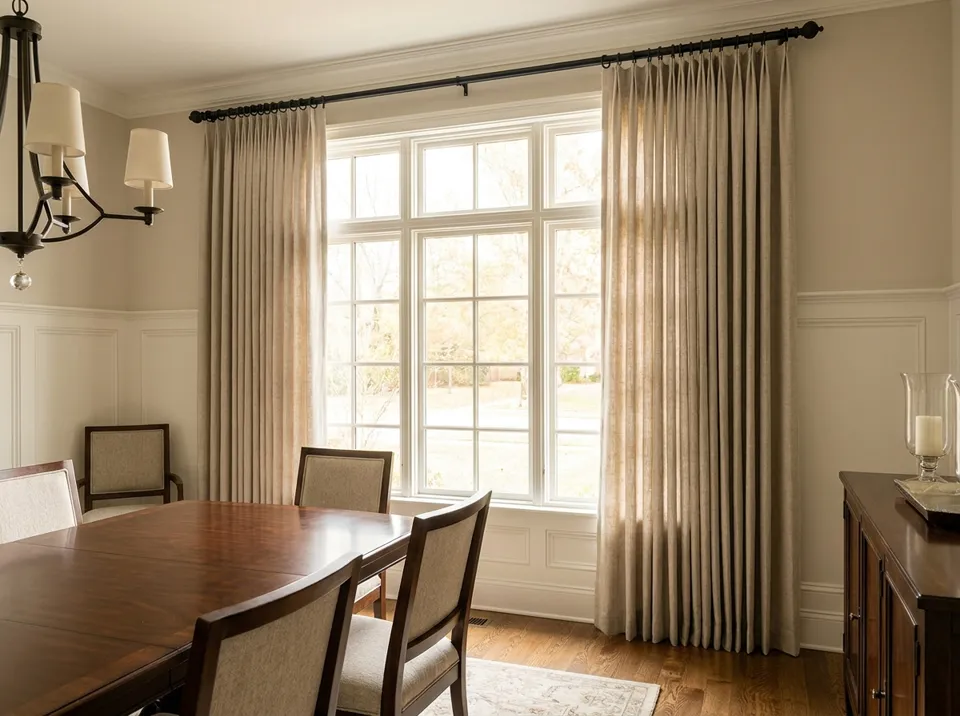
Custom drapery in Federal Way, WA is the answer for windows the store sizes can't serve: 9-foot sliders, two-story great-room glass, and openings three inches out of square. This 2026 guide covers fabric weight, fullness, lining, and hardware for Federal Way homes, drapes versus shades by room, and how a local crew measures, orders custom-made panels, and installs them in one visit.
TL;DR
- Custom drapery Federal Way WA homes need when store panels are too short, too flat, or the wrong weight.
- Two times fullness is the standard for real folds; one-time fabric reads like a sheet.
- Blackout or thermal lining turns drapes into a sleep and comfort tool.
- Shades handle light control; drapes add scale and finish. Most rooms run both.
- Rainier Blinds measures, orders custom-made panels from a supplier, and installs with our own crew.
Key numbers
Why Federal Way windows need custom drapery
Federal Way's housing stock makes off-the-rack panels a bad bet. The city mixes 1990s two-stories with tall great-room windows, newer builds with sliders and window walls facing the water, and older ranches with low 60-inch openings. Ready-made drapes come in three sizes — 84, 95, and 108 inches — and the size the window actually needs is usually none of them. A panel that floats 6 inches above the sill or puddles on the floor announces itself every time you walk into the room.
The second gap is fullness. A store panel carries roughly one time fullness: fabric laid flat against the rod, no folds to catch light, no body to stop a draft. It hangs like a sheet. Custom drapery is made with two times fullness as the standard — twice the fabric width gathered onto the same rod — and that is the difference between drapery and a rectangle.
The third gap is lining. A Federal Way window in 2026 works hard all year: glass runs cold from November through March, and low-angle summer sun off west-facing glass fades rugs and furniture. Thermal lining cuts the cold, blackout lining darkens a bedroom, and either takes the UV hit so the face fabric keeps its color.
Federal Way sits on the crew's regular South King County route. Scheduling and coverage details live on the Federal Way service area page, and everything below is the decision list walked through on the first measure visit.
What custom drapery solves that off-the-rack doesn't
Exact length and exact stack
Custom panels are cut to the measured drop, not to the nearest catalog inch. A slider with 96 inches of clear glass gets a panel that hangs to the floor and stacks fully off the glass when open. A two-story great-room window gets a panel that runs nearly floor to ceiling. Hemming a store panel by hand rarely ends well — the finished edge is already stitched, and a bad hem shows on every fold.
Stack width matters as much as length. A two-times-fullness panel stacks back over roughly a third of its rod, so the rod or track gets planned wider than the glass before anything is ordered. On a slider, that means drapes that disappear against the wall when open instead of a permanent fabric column down the middle of the door.
A fabric range the shelf doesn't carry
Custom suppliers offer hundreds of weaves, weights, and colors — linen-look textures, deep velvets, tight weaves with a bonded liner — that no big-box chain stocks in any quantity. The face fabric gets picked for the room: loose, soft weave in a living room; dense weave with a liner in a bedroom; performance blends wherever kids or a dog work the panels daily.
Ready-made means one fabric weight, one hem, and whatever color the shelf holds this season. Custom means the panel matches the room it hangs in, on the first try.
What to look for in custom drapery for Federal Way homes
Fabric weight and opacity
Drapery fabric comes in four opacity tiers, and the label decides the job. Sheer passes daylight and silhouettes; light-filtering softens sun and blocks the view in; room-darkening cuts most direct light; blackout blocks nearly all of it. The common mistake is treating a dark sheer as private — at night, interior light turns a sheer-covered window into a display for the street.
Weight does a second job. A heavier weave hangs straighter, folds deeper, and blocks more draft at the panel edge. Light fabrics suit casual rooms and short drops; heavy weaves earn their keep on tall glass and bedrooms.
Fullness and pleat style
Two times fullness is the working standard: for a 100-inch rod, roughly 200 inches of fabric gathered onto it. Push to 2.5x for lush, formal folds. Drop to 1.5x on a tight budget and accept a flatter look. One-time fullness is the store look — skip it on any window you actually see every day.
Pleat style is taste, not function. Pinch pleats are the default and hold their shape for years. Goblet pleats read formal and suit traditional rooms. Ripplefold on a track stacks tighter than anything on a rod, which suits modern Federal Way great rooms with a lot of glass and not much wall.
Lining: thermal, blackout, and interlining
Lining is where a panel starts performing instead of just hanging. Thermal lining insulates the glass — on older single- or double-pane windows, a lined panel takes the January chill out of a sofa by the window. Blackout lining takes a bedroom to near-dark. Interlining adds a middle layer that gives lightweight face fabric the body and drape of a heavy one.
The honest limit: lining alone rarely makes a room truly dark. Light leaks around the panel edges unless the drape wraps well past the window or layers over a shade. For real darkness, plan drapes over blackout shades, not instead of them.
Hardware, rods, and motorized tracks
Rods and tracks belong in the project quote, not the accessories aisle. Wide openings need sturdy rods or a ceiling-mounted track — a budget rod bows under real fabric weight within a year. Motorized drapery tracks, battery or plug-in, remote or phone app, solve two Federal Way problems at once: sliders too wide to reach across, and two-story windows nobody wants to ladder up to. Motorize the panels you touch every day; leave the formal dining room on a manual rod.
Drapes, shades, or both: picks by room
Shades and drapes do different jobs. Shades sit tight to the glass and handle daily light control and insulation; drapes add scale, softness, and the finished look. Most Federal Way rooms in 2026 run both — a shade doing the light job, drapes framing it. The shade-versus-drape tradeoffs for Auburn rooms work the same way and are covered in our custom drapery in Auburn guide.
| Room | Best pick | Why | Verdict |
|---|---|---|---|
| Living room | Light-filtering shades under 2x drapes | View by day, softness at night | Buy both |
| Bedroom | Blackout shades with lined drapes over | Layered dark, no edge glow | Buy both |
| Media room | Blackout roller in side channels | Tightest light seal available | Shade only |
| Sliding glass doors | Motorized drapery on a ceiling track | Full clearance, one-touch open | Buy drapes |
| Dining room | Light-filtering drapes | Soft dinner-hour glow | Drapes alone |
| Entry and transoms | Custom drapery or fabric cornice | Dresses odd-height glass | Drapes |
What to avoid
Store panels on non-standard windows
The most common Federal Way drapery mistake is a pair of 84-inch panels hung on 9-foot glass — too short, too narrow, and one-time fullness besides. If the window is not a standard height, ready-made cannot look right. The hem exists, the length is fixed, and no rod trick hides it.
Unlined panels on sun-facing glass
Unlined drapery on west- and south-facing glass fades within a few summers and does nothing for the cold coming off the glass in winter. Lining roughly doubles panel life on those exposures and pays for itself in comfort.
Online self-measure orders
Custom fabric cut to numbers typed off a tape measure is rarely returnable, and drapery exposes every error — a panel 1 inch short reads broken, a rod guessed wrong stacks over the glass. The measure visit records three readings per window and settles the mount on the real frame. That visit is the reason the quote is accurate the first time.
Verdict comparison
| Option | Best for | Key detail | Verdict |
|---|---|---|---|
| Custom drapery at 2x fullness | Living rooms, sliders | Exact drop, real folds | Buy |
| Blackout-lined drapes | Bedrooms | Near-dark with a finished look | Buy |
| Thermal-lined drapes | Older single-pane glass | Cuts the winter draft feel | Buy |
| Drapes layered over shades | Rooms with two jobs | Shade does light, drapes do finish | Buy both |
| Ready-made 84-inch panels | Almost nothing in Federal Way | Wrong length, 1x fullness | Skip |
How the measure, order, and install process works
We bring fabric samples to your home and help you choose the weave, texture, and finish in your own light. Your shades are custom-made to your measurements, and our local crew handles measuring and installation.
- Consult and measure: on-site, room by room — which rooms need dark, which need daylight, three width and height readings per window, casing depth, and every crank or sensor noted.
- Quote on the spot: real pricing before we leave, on every window in the project, including lining, hardware, and any motorized track. Standard rectangular windows start from $275, backed by a warranty of up to 5 years depending on package.
- Custom-made by the supplier: fabric cut and pleated to the measurements, typically arriving 2 to 4 weeks after the order is confirmed.
- Install: usually one visit. Tracks leveled, panels dressed, and the fold checked before the crew leaves.
The full range Rainier Blinds measures and installs — shades, drapery, motorized tracks — is on the custom window treatments services page.
FAQ
How much does custom drapery cost in Federal Way, WA in 2026?
Are custom drapes worth it over ready-made panels?
Do custom drapes block out light for sleeping?
What does drapery fullness mean?
Should I choose drapes or shades for my Federal Way home?
How long does custom drapery take to make and install?
Can drapery tracks be motorized?
How do I clean custom drapery?
One last thing
The detail that decides how custom drapery looks for the next 10 years is the mount, and it happens before the fabric ever arrives. A track mounted at the ceiling line and extended a few inches past the casing on each side makes a 9-foot window read even taller and gives the open panels somewhere to disappear. Mount the rod low and tight to the trim, and even a custom panel reads like a store one.
Then decide the daily habit before ordering. Panels opened every morning on a slider belong on a motorized track; panels that stay closed in a guest room belong on a simple rod. The measure visit answers both — and in 2026 that visit is the free quote.