
Our available controls: Rainier Blinds offers Roman and woven wood shades with motorized operation only. All other shade styles are available with manual, motorized, or smart control. Your consultation confirms the controls and power options for your product.
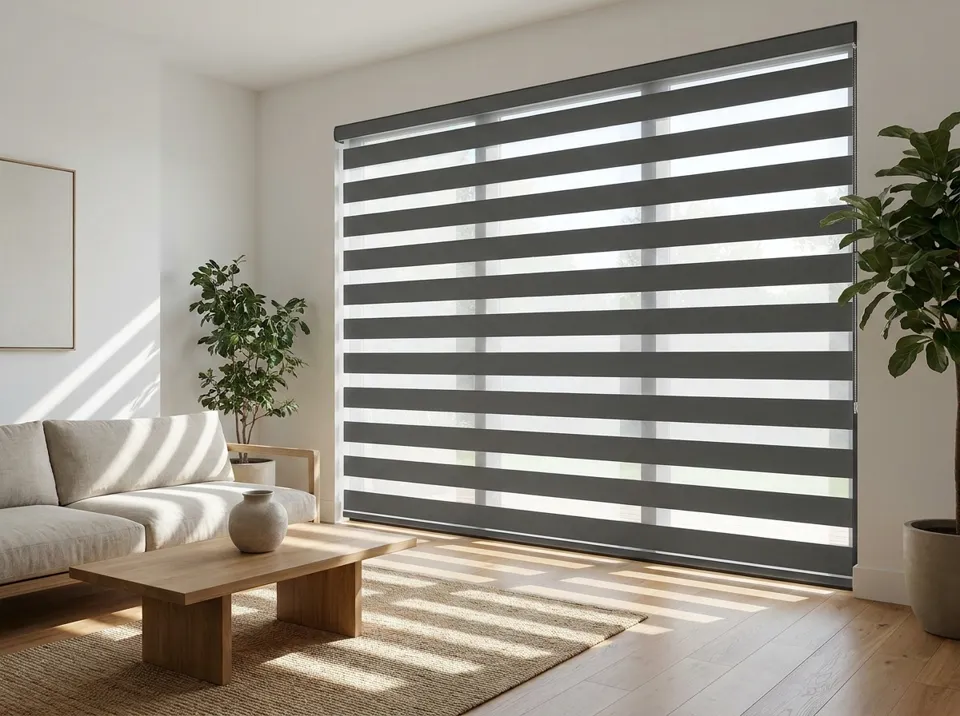
Zebra shades in Maple Valley, WA solve the lighting problem this corner of South King County has more than anywhere else: lots under a heavy evergreen canopy, where interior light arrives filtered, moves all day, and drops early. A zebra shade answers moving light better than any other window treatment because alternating sheer and solid bands let you dial the room in half-inch steps instead of forcing a choice between open and closed. This 2026 guide covers how the bands work, which opacity fits which exposure, what tall two-story glass changes, where the honest limits are, and how local measure-and-install pricing works for Maple Valley homes. Coverage and scheduling details sit on the Maple Valley service area page.
TL;DR
- Zebra shades are the Buy for Maple Valley great rooms and offices: light dials in half-inch steps.
- Room-darkening bands suit street-facing rooms and evening headlight glare.
- Tall two-story glass in newer builds wants motorized lift, recharged every 6-12 months.
- No zebra shade goes truly dark — bedrooms need blackout roller shades instead.
- Rainier Blinds measures on site, has shades custom-made to your exact measurements, and installs with our own crew.
Key numbers
Why this matters
Maple Valley sits against the Cascade foothills, and its lots look nothing like the open subdivisions farther west. Douglas firs and hemlocks line the ravines behind homes in the four-lake area, around Lake Wilderness, and along the older plats near the valley floor. That tree canopy is the neighborhood's best feature and its hardest lighting problem. Sunlight arrives already filtered, tracks slowly across living room floors as it moves behind trunks and branches, and disappears early — in November and December, a tree-shaded room loses usable daylight by mid-afternoon, and even in July the light never sits still.
A window treatment with two settings handles a room like that badly. Curtains are open or closed. A standard roller is up or down. A zebra shade runs two fabric layers on a single roller — a sheer band and a solid band, alternating — so sliding the shade a half inch changes the light. You can hold a living room at "half covered" all afternoon while the canopy light shifts, which is a setting no curtain or single-fabric roller offers. On a Maple Valley lot where the right setting is different at breakfast, at 2 p.m., and at dinner, that middle range is the whole product.
The failure mode is honest to name: zebra shades never go truly dark. The solid bands sit beside the sheer bands, not over them, and light still travels around the roll no matter how the shade is set. On a newer Maple Valley subdivision street, where houses stand 15 to 20 feet apart, a light-filtering zebra in a street-facing bedroom leaves a glowing outline at dawn and a silhouette problem at night once the interior lights come on. The 2026 rule holds in every guide on this site: zebra for the rooms you live in while the sun is up, blackout for the rooms you sleep in.
Who this is for
This guide is for Maple Valley homeowners deciding whether zebra shades are the right product for specific rooms: great rooms with two-story glass, home offices with moving screen glare, street-facing living rooms, and dining rooms that need bright at noon and private at six. It is written for buyers comparing a local measure-and-install shop against online shade carts and big-box shelves, not for renters hunting a temporary fix.
If the primary problem in the house is darkness for sleep or heat loss through old glass, zebra is the wrong tool, and the picks below say so plainly. If the problem is a room whose light is never quite right at any single setting — the most common lighting complaint we hear from tree-shaded Maple Valley lots — read on. That is exactly the job this shade does.
What to look for in zebra shades for Maple Valley homes
Band width and opacity
Zebra fabric comes in two opacity families: light-filtering bands that soften daylight while keeping the view, and room-darkening bands that cut considerably more light for street-facing rooms and media-adjacent spaces. Band widths also vary by line — wider bands read as a bolder stripe across tall glass, narrower bands blend more quietly on standard windows. Neither is better; they are two different reads on the same room.
Decide on the samples at your window, not the sample ring in a store. A band that looks refined under showroom lighting can read busy across a two-story great room wall, and a room-darkening band that seemed like overkill on an overcast morning is exactly right at 10 p.m. with headlights sweeping the street. The measure visit is where this decision belongs.
Tall glass and motorization
Newer Maple Valley construction runs tall: two-story entries, great-room glass walls, transoms over entries and stairwells. A manual zebra shade on a 14-foot opening means a stepladder twice a day, and shades that need a ladder to adjust end up parked in one position for years — which throws away the one thing that makes a zebra worth buying.
Motorize anything above reach. Battery motors pair with a remote or phone app and recharge roughly every 6 to 12 months depending on use. In 2026, Rainier Blinds lists its Motorized package at +$100 per shade and its Smart package at +$200 per shade; smart-package motors run on Matter and pair with Apple HomeKit, Alexa, Google Home, and SmartThings, so a great room can drop at sunset and open in the morning on a schedule.
There is also a zebra-specific reason to motorize tall glass: a zebra shade's best-looking position is its bands aligned evenly across the window, and on a tall run, aligning that by hand is guesswork. A motor parks at a memorized alignment position every cycle, at the push of one button.
Inside mount or outside mount
A zebra shade carries two fabric layers, so its cassette is deeper than a single roller's. Inside mount needs casing depth to seat the cassette cleanly and keep the trim line intact; on the shallow trim common in production builds, an outside mount that overlaps the opening is the honest answer, and it also covers the light gap on an out-of-square frame. Settle the mount at the measure visit, before anything is ordered — custom fabric cut against a wrong mount assumption is not returnable.
Cordless lift and safety
Cordless spring lift is the 2026 baseline on any shade within reach of children or pets, and it removes the dangling loop entirely on family rooms and hallway windows. A continuous-loop chain still earns its place on tall or room-darkening spans, where a spring lift would fight the fabric's weight — on those, keep the loop anchored to the frame with the provided tensioner.
Where zebra sits against the other shades
- Versus roller shades: a roller gives one setting per fabric at a lower price. Zebra adds the fine dial. If a room genuinely lives at one setting, buy the roller.
- Versus cellular shades: cellular traps air and insulates; zebra does not. Cold-glass rooms and bedrooms stay with cellular.
- Versus day/night and dual shades: those stack two full fabrics for two true settings, including real blackout, at a deeper cassette and higher price. Zebra is the cleaner answer when many small settings beat two extremes.
Top picks for Maple Valley homes
The all-day pick: light-filtering zebra in the great room
Buy. This is the room zebra shades were built for. Canopy light shifts hourly, the great room is in use all day, and the choice between glare and cave is a bad one — the zebra's half-inch steps hold the middle all afternoon. Custom-made to your measurements after an on-site measure, not trimmed from a stock chart.
The street-facing pick: room-darkening bands
Buy. Newer subdivision lots put living rooms and front windows close to the street, which means a daytime view question and an evening headlight sweep. Room-darkening bands close the view in without committing the room to a blackout product, and the daytime setting keeps most of the light.
The tall-glass pick: motorized zebra on two-story runs
Buy when the glass is above reach. One remote runs the whole elevation, the schedule handles the daily open and close, and the alignment position stays repeatable on every cycle. This is the pick that keeps a two-story great room's shade in daily use instead of parked half-open.
The office pick: zebra on the home-office window
Buy. Screen glare is the defining home-office problem, and it moves with the sun. A zebra shade is the fastest fix in the lineup: nudge the bands until the monitor stops washing out, without closing off the view of the yard.
The skip: zebra in bedrooms
Skip. No zebra shade delivers real darkness — the bands never fully overlap, and light finds the gaps at the edges. A blackout roller shade in an outside mount does the bedroom job better and costs less. Order zebra where people are awake; order blackout where they sleep.
What to avoid
Self-measured online zebra orders
Zebra fabric cut from one centerline tape reading rarely fits a real opening. Older Maple Valley plats have frames that settled out of square decades ago, and newer builds carry shallow casings that change the mount. Custom fabric cut to wrong numbers is rarely returnable at full value, and an online cart has no crew to call when the bands bind.
One band opacity for the whole house
Room-darkening bands in a north-facing office feel heavy by noon; light-filtering bands on a street-facing front window become a privacy problem after dark. Match the band to the exposure, room by room, the way you would match a fabric to a job.
Zebra where blackout is the real job
If the sentence that starts the project is "we cannot sleep past 5 a.m. in June," the answer is blackout, not zebra. Buying zebra and then layering blackout panels over it later doubles the cost of solving one problem.
Motors with no local service path
A motor that needs a shipping label is a shade that stops being used. Buy motorization where the crew that installed can come back and service it, and confirm the motor and labor are covered under the package warranty, not shipped back to a factory.
Verdict comparison
| Pick | Best for | Key detail | Verdict |
|---|---|---|---|
| Light-filtering zebra | Great rooms, all-day spaces | Half-inch light dialing | Buy |
| Room-darkening bands | Street-facing rooms | Evening privacy and glare | Buy |
| Motorized zebra | Two-story and tall glass | Remote, app, schedules, one-touch align | Buy above reach |
| Zebra in a home office | Screen glare | Fastest light adjustment | Buy |
| Zebra in bedrooms | Darkness | Never fully dark | Skip |
| Stock zebra from a cart | Almost nothing | Self-measure, no service | Skip |
How local measure, custom-make, and install works
Rainier Blinds is a measure-and-install company based in Auburn. Our own crew — not a subcontractor — measures every opening in the project, the shade is custom-made by an established wholesale supplier to those measurements, and the same local crew comes back to install. Manufacturing stays with the supplier; the fit, the follow-up, and the accountability stay local. That split is the part that decides whether a zebra shade's bands line up across a 14-foot run, and it is the part an online cart cannot sell you. The full range this process covers — roller, cellular, woven wood, roman, drapery, and the rest — sits on our custom window treatments page.
- Consult and measure: on site, room by room. Three widths and three heights per opening, casing depth checked, exposure noted for every room, and fabric samples held against your glass in your light — not under store LEDs.
- Quote on the spot: real pricing before we leave, on every window in the project. Standard rectangular windows start from $275, backed by a warranty of up to 5 years depending on the package.
- Custom-made by the supplier: fabric and hardware built to the confirmed measurements, typically arriving 2 to 4 weeks after the order.
- Install: usually one visit. Motors paired, travel limits set, the band-alignment position saved, and every shade cycled through open, aligned, and closed before the crew leaves.
Start with the free in-home quote — requests get a response within 1 business day, and the measure visit is where every decision on this page actually gets made.
FAQ
What are the best zebra shades for Maple Valley WA homes in 2026?
How much do zebra shades cost in Maple Valley, WA?
Are zebra shades good for bedrooms?
Can zebra shades be motorized?
Zebra shades vs roller shades: which should I choose?
Do zebra shades give privacy at night?
How long does it take to get custom zebra shades installed?
Does Rainier Blinds make zebra shades in-house?
One last thing
The detail most Maple Valley homeowners miss in 2026 is band alignment, and it shows up in the first week. A zebra shade's best-looking position is its solid bands aligned evenly across the window, and on a tall or wide opening, aligning that by eye every time is exactly why so many zebra shades end up parked half-open. Two fixes cost nothing at order time: save the motor's aligned position as a one-touch preset, and have the installer demonstrate the open, aligned, and closed positions from the room's actual seating before the crew leaves. Then do the dusk test that same night — turn on the interior lights and walk to the curb. What you see from the street is what the neighborhood sees, and that five-minute walk settles the privacy question better than any sample ever will.