
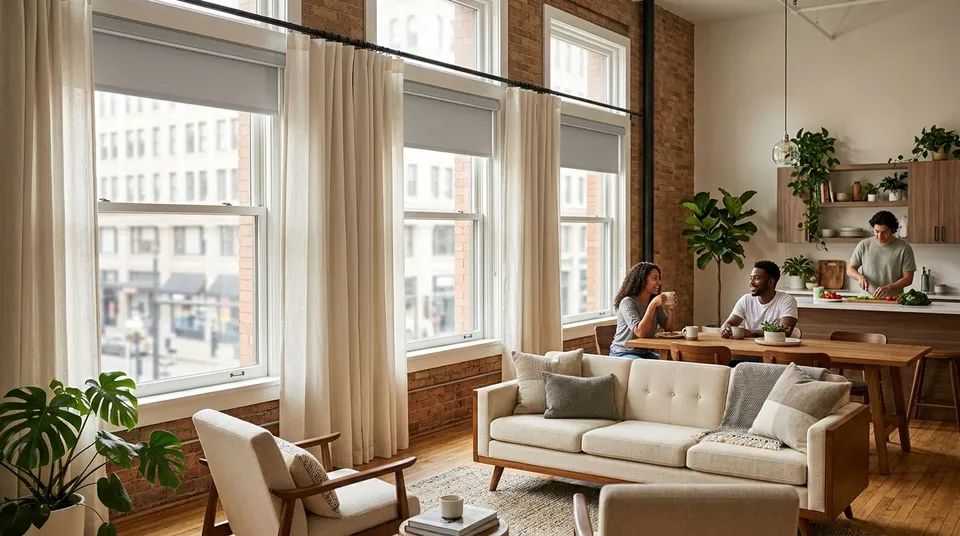
Window treatments for co-living rentals need to survive multiple tenants, standardize easily across units, and give each renter real bedroom privacy without turning into a maintenance headache for the property owner. A single-family homeowner picks one look for one household; a co-living operator picks one spec that has to work in eight bedrooms with eight different sleep schedules and zero patience for broken cords.
- Cordless cellular and roller shades are the two most durable window treatments for co-living rentals in 2026 because they have no cords to snap during turnover.
- Standardizing on one shade type across a shared house cuts install time and replacement cost versus mixing styles room by room.
- Skip corded shades entirely in shared housing where the tenant mix changes year to year.
- Motorized shades reduce landlord service calls in buildings with 6+ bedrooms because tenants cannot jam a cord that is not there.
Why this matters for co-living and shared housing rentals
Co-living operators and multi-family property managers deal with a turnover rate a single-family landlord never sees. A four-bedroom co-living house in South King County can turn one or two rooms a year at minimum, more if leases run month to month. Every turnover means a window treatment gets touched, adjusted, or occasionally yanked off the wall by a mover who did not know it was anchored.
Stock shades fail under that use pattern faster than they fail in an owner-occupied home. A cord snaps, a headrail cracks, and the property manager is paying for a service call instead of collecting rent. The fix is not fancier window treatments. It is picking the right operation type and mount for a building where nobody treats the shades like they own them.
Step 1: Standardize the shade type across every bedroom
Picking one window treatment type for the whole property, rather than letting each tenant choose or inheriting whatever the previous owner installed, cuts both cost and confusion.
- Use one shade style (roller, cellular, or zebra) across all bedrooms so spare units are interchangeable
- Keep the same headrail color and mount type per room size to speed up future installs
- Document exact width and drop measurements per window so reorders do not require a fresh measure visit
- Avoid mixing operation types inside one unit, since tenants assume every window works the same way
Standardization is the single biggest cost lever in a co-living portfolio in 2026. Five different shade types across five bedrooms means five different repair processes.
Step 2: Go cordless in every bedroom, no exceptions
Co-living houses turn tenants fast, and you rarely control who moves in next. A family with toddlers can take a unit last occupied by three roommates in their twenties. Cordless operation removes the risk permanently instead of relying on every future tenant reading a warning tag.
- Choose cordless cellular or roller shades in every bedroom, not only the units currently housing children
- Skip corded and continuous-loop operation across the whole property
- Review cordless shades for households with toddlers if you are unsure what counts as fully cordless
- Confirm any window coverings inherited from a prior owner meet the same standard before relisting the unit
Step 3: Prioritize durability over decoration in common areas
Shared kitchens, living rooms, and laundry nooks get more daily hand contact than any private bedroom. Fabric weight and hardware strength matter more here than color coordination.
- Pick roller shades with a heavier fabric weight for kitchens and shared living rooms
- Specify metal headrails over plastic in any room used by more than three people daily
- Avoid delicate sheer fabrics in high-traffic shared spaces
- Confirm mount hardware suits the wall type, not just the window frame, since shared houses often sit in older Auburn and Kent housing stock
Step 4: Solve privacy room by room, not house by house
Every bedroom in a co-living rental needs independent light and privacy control. One tenant on night shifts needs near-total darkness while a roommate down the hall wants morning light. Treating the whole house as a single privacy zone is the most common planning mistake operators make.
- Install blackout or room-darkening cellular shades in bedrooms used by shift workers and light sleepers
- Use light-filtering roller shades in bedrooms that double as daytime home offices
- Add a liner to zebra shades in rooms facing a street or shared courtyard for real nighttime privacy
- Give every bedroom window independent operation so roommates never share a control
- Check shade opacity choices for privacy and natural light before locking a spec across the property
Step 5: Decide manual versus motorized based on unit count
A single co-living house with four or five bedrooms rarely needs motorization. A property manager running a dozen units across multiple buildings faces different math.
- Manual cordless shades are enough for houses under six bedrooms with a stable tenant base
- Motorized shades cut service calls in larger buildings because there is no cord or wand to break
- Battery-powered motorized shades avoid running new wiring through rented walls, which matters in older Greater Seattle housing
- Rainier Blinds measures every window during a free in-home consultation, so the manual-versus-motorized call gets made against the actual windows rather than a floor plan
Get a consultation for your rental property
Free in-home measure and real pricing on the spot for co-living and shared housing units.
Step 6: Plan for turnover before it happens
The biggest operational cost in co-living window treatments is not the first install. It is what happens every time a tenant moves out and the next one moves in.
- Keep a written spec sheet per window covering size, mount type, and fabric so a replacement order takes minutes
- Plan on roughly one replacement shade per unit per year in high-turnover properties
- Review window treatments built for short-term rental turnover if any bedrooms rotate weekly or monthly
- Avoid adhesive-mount shades that pull paint off the wall during removal between tenants
Comparison: window treatment options for co-living rentals
| Option | Best for | Key limitation |
|---|---|---|
| Cordless cellular shades | Bedrooms needing insulation plus full blackout | Room-darkening versions run higher than a plain roller |
| Roller shades | Kitchens and shared living rooms with heavy daily use | Less thermal insulation than cellular in drafty older houses |
| Zebra shades | Shared living rooms wanting adjustable light without full blackout | Costs more per window than a basic roller |
| Motorized shades | Managers standardizing across 10 or more units | Needs a battery charge or swap schedule per unit |
| Drapery | Shared lounges where softening noise matters | Hard to standardize across mismatched window sizes |
Verdict: cordless cellular shades are the strongest default for co-living bedrooms in 2026, and roller shades win for the shared common rooms that take the most daily contact.
Common mistakes co-living operators make
- Buying corded shades because they are cheaper upfront. Two years of service calls from snapped cords costs more than going cordless the first time.
- Letting each tenant pick their own window treatment. It looks fine until the unit is relisted and repairs need three different part numbers.
- Skipping the liner on street-facing bedrooms. A roller shade with no blackout liner produces a complaint from a night-shift tenant inside two weeks.
- Reusing whatever the previous owner left behind. Inherited stock blinds are usually the first thing that breaks under new tenant traffic.
- Not documenting measurements per unit. Without a spec sheet, every turnover needs a fresh site visit instead of a quick reorder.
FAQ
What window treatments work best for co-living rentals?
Cordless cellular shades for bedrooms and heavier roller shades for shared common rooms hold up best in co-living rentals in 2026. Both remove the cord-breakage risk that comes with constant tenant turnover.
Should I use motorized or manual shades in a shared rental?
Manual cordless shades are enough for a single co-living house under six bedrooms. Motorized shades make more sense for managers running multiple buildings, since there is no cord for a tenant to jam or break.
Are corded shades a problem in shared housing with roommates?
Corded shades are a risk any time the household composition can change, which is constant in co-living housing. Cordless operation removes that risk without tracking who lives in which bedroom.
How often do window treatments need replacing in a high-turnover rental?
Plan on roughly one shade replacement per unit per year in high-turnover co-living properties. Standardizing on one shade type keeps that replacement cost predictable.
Do all bedrooms in a co-living house need blackout shades?
No, but any bedroom used by a shift worker or light sleeper should get a room-darkening or blackout cellular shade. Light-filtering shades are enough for rooms occupied mainly during the day.
What is the cheapest way to standardize shades across multiple rental units?
Pick one shade style and headrail color per bedroom size across the portfolio, then keep a written measurement sheet for every window. Future replacements become a reorder instead of a new measure and install visit.
Can property managers get one quote covering multiple units?
Rainier Blinds measures and quotes during a free in-home consultation that can cover multiple bedrooms or units in the same visit. Coverage includes Auburn, Kent, Tacoma, Bellevue, and the wider Greater Seattle Area.
Do shades need to match between bedrooms and common areas?
They do not need to match, but every bedroom should share one spec. Common areas can run a heavier roller shade fabric because they take far more daily handling than a private room.
One last thing
The window treatment that fails first in a co-living house is almost never the one in the nicest room. It is the cheapest corded shade in the bedroom that turns over most often. Operators who standardize on cordless shades across every bedroom, not only the rooms currently housing kids, cut service calls the most because the fix stops depending on who is renting that room in 2026. Rainier Blinds measures and installs with its own crew rather than a subcontractor, which matters most in properties where a bad measurement means a second trip into a unit that already has a new tenant unpacking.