
Consultations are free within 60 driving miles of Auburn. Farther projects are considered individually; any consultation or travel fee is quoted before booking and credited toward your order if you proceed.
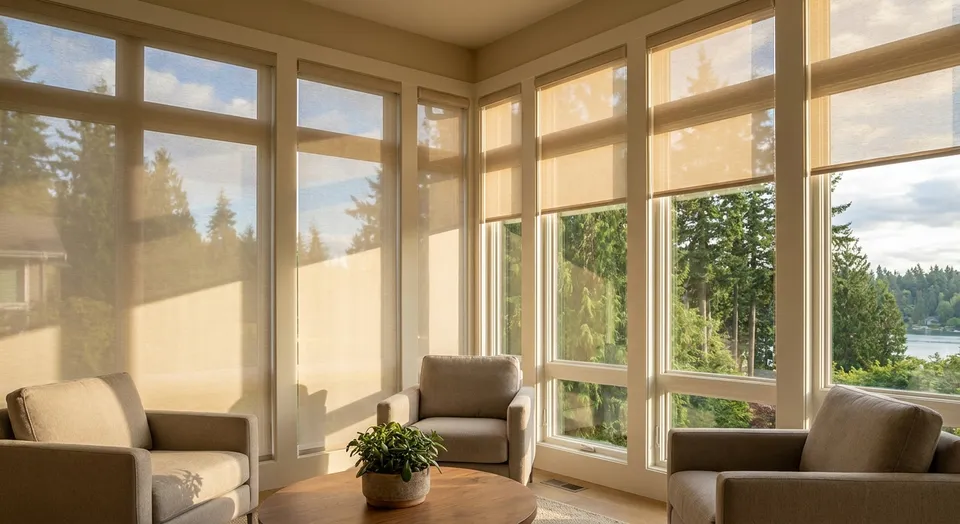
Sheer shades are what most people name when they want a sunroom to stay bright and still be livable at 10 in the morning. Worth saying up front: Rainier Blinds does not carry sheer horizontal shades, the fabric-vane style sold under names like Silhouette. What we do install solves the same sunroom problem, often better on the angled and oversized glass these rooms are built from. This 2026 guide covers what actually controls glare in an Auburn, Kent, or Federal Way sunroom, which product to pick for which window, and what to skip.
TL;DR
- Rainier Blinds does not sell or install sheer horizontal shades. The alternatives below cover the same job.
- Light filtering roller shades are the direct replacement: same diffused light, one flat fabric, far less hardware to fail on sunroom glass.
- Zebra and dual shades give you a sheer view and a private room from one shade, which is the closest thing to how a sheer horizontal is marketed.
- Fabric openness, not color, is the number that decides whether you can look at a laptop screen in there.
- Sunrooms usually need a motor. The glass is tall, angled, or both, and a shade you cannot reach never gets adjusted.
Why this matters
A South King County sunroom is glass on three sides, which means it takes low-angle sun from before 8 in the morning through the afternoon, plus the long June and July photoperiod where the sun is up past 9 at night. That is far more direct exposure than any other room in the house, and it is why sunroom window treatments fail in ways living room shades do not: fabric fades, cheap hardware warps, and anything opaque defeats the entire reason the room was built.
The other half of the problem is geometry. Sunrooms run floor to ceiling glass, transom rows above eye level, and angled or trapezoid panels where a roof line meets a wall. That geometry is what rules out a lot of products, and it is the main reason we point sunroom customers toward flat fabric systems instead of vane-based ones.
What we install instead, and why
Sheer horizontal shades work by suspending fabric vanes between two sheer facings. It is a good looking product. It is also a lot of moving parts hanging in the harshest UV exposure in the house, on glass that is frequently angled. We chose not to carry it. Here is what covers the same ground.
Light filtering roller shades: the direct swap
This is the honest replacement for a sheer horizontal. One flat fabric on one roller, in a light filtering weave that diffuses the sun and keeps the view without going dark. No vanes to sag, crease, or collect dust, and the flat profile handles a tall sunroom window without the hardware getting heavier as the window gets bigger.
The number that matters here is fabric openness, the percentage of the weave that is open. A tighter weave cuts more glare and more UV and gives you more daytime privacy, an opener weave keeps more of the yard. For a sunroom with real direct exposure, you want a tight weave. We bring the fabric book to the measure and hold samples against your actual glass, because openness reads completely differently in a north-facing room than it does in a south-facing sunroom.
Zebra and dual shades: sheer and private from one shade
If what you liked about sheer horizontals was the two-in-one behavior, this is the closer match. Alternating sheer and opaque bands on one fabric roll. Line the opaque bands up and the room goes private. Rotate them open and the light comes back without raising the shade. That is the same daily experience a sheer horizontal is sold on, from a mechanism with far less to go wrong.
Honest limit: with the bands open you have a sheer, not a blackout, and at night interior lights make the room softly visible from outside. Sunrooms rarely care about that. Bedrooms do.
Day/night and cellular: when the sunroom is a real room
If your sunroom is insulated and used year round rather than three seasons, a day/night shade pairs a light filtering layer with a blackout layer on one headrail, and cellular fabric adds an insulating air pocket against the glass. A sunroom is the leakiest envelope in the house, and in a region where heat runs most of the year, that pocket does measurable work in both directions.
Trapezoid, arched, and skylight shapes
Angled glass where the roof meets the wall, and the shaped panels above sliders, are their own product rather than a standard shade cut on a diagonal. We measure and order these to the actual angle. This is the single most common thing homeowners try to solve with an off-the-shelf product and cannot.
Motorization on sunroom glass
Most sunroom jobs end up motorized, and not as an upsell. The glass is tall, frequently above a fixed bench or planter, and often angled. A manual shade on a window you need a step stool to reach is a shade that stays in one position for a year.
The Motorized package adds $100 per shade and the Smart package adds $200 per shade. Confirm the exact shade, power, motor, controller, and included features in your quote. Smart-home support depends on the exact motor, controller, protocol, and hub. We confirm support for your preferred platform and the available features before ordering.
What to skip in a sunroom
Anything blackout as the only layer. You built the room for the light. Blackout belongs as a second layer on a day/night, not as the whole answer.
Stock sizes cut close enough. Sunroom openings are rarely standard, and a shade that misses by half an inch leaves a glare gap right at eye level.
Untreated fabric in direct exposure. Ask what the fabric is rated for. South and west facing sunroom glass is the hardest UV environment in the house, and an unrated fabric shows it in a couple of seasons.
Solving angled glass with a rectangular shade. It will not track straight and it will not seal at the short edge.
How the measure and install works
- in-home measure. We come to the sunroom, measure every opening, and check mount depth and angles at the actual glass.
- Samples in your own light. Fabric openness is impossible to judge from a screen, so we hold options against your window at the hour the room is worst.
- a quote for your selected products. Each window is included in your measured quote. Our lowest-priced manual shade starts around $275 for a standard 32×48-inch window, with basic installation included. Other styles, sizes, fabrics, and controls are quoted separately.
- Production and installation timing depend on the selected fabric, hardware, supplier availability, and project scope. We confirm the current estimate for your order before you plan around a completion date.
- One install visit. Our own crew hangs them, pairs motors, and sets limits before leaving. Package warranties run 1 year on Standard, 3 years on Motorized, and up to 5 years on Smart.
We cover Auburn, Kent, Federal Way, Renton, and the rest of South King County from our Auburn home base. Start with the in-home quote once you know which rooms are in play, or see the full lineup on the custom window treatments page.