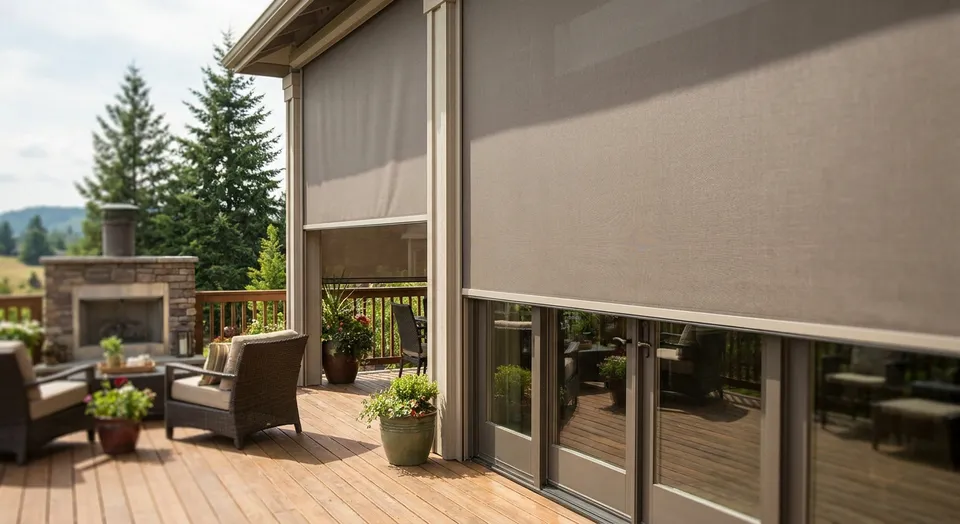
Auburn decks and patios face real Pacific Northwest weather, wind off the valley, sideways rain nine months a year, and enough summer sun to fade a deck sectional in two seasons. Outdoor shades solve all three problems if you pick the right track system and fabric weight for the space you're covering.
- Zipper track outdoor shades handle wind gusts up to 50 mph and suit most Auburn WA decks. Buy for exposed spans.
- Steel cable outdoor shades cost less and cover wider openings but flap more in gusty conditions.
- Motorized outdoor shades for sliding glass doors are the right call once a span crosses 10 feet.
- Skip faux wood, aluminum, or wood-style blinds outdoors in 2026. They warp and corrode within a season.
Why this matters
A patio without a shade system loses three or four usable months a year in Auburn, either too much sun on the west side or too much rain blowing sideways under the eaves. Outdoor shades close that gap without walling in the space. The mistake most homeowners make is buying an indoor-rated shade or a cheap retractable awning fabric that wasn't built for direct weather exposure. Custom window treatments in Auburn already covers the indoor side of that decision. This guide is strictly about what holds up outside.
Who this is for
This is for Auburn homeowners with a covered or partially covered patio, a deck off the kitchen or living room, or a sunroom-adjacent slider that turns into a greenhouse every July. If your space gets direct west or south sun for more than four hours a day, or if wind off the valley rattles patio furniture, an outdoor shade system built for exterior exposure, not an interior roller shade dragged outside, is the right category to shop in 2026.
What to look for in outdoor shades for Auburn patios and decks
Wind and weather rating
An outdoor shade that isn't rated for wind will tear at the seams or rip off the track within a year. Zipper track systems in this category are typically rated for gusts up to 50 mph because the fabric edges lock into a channel on both sides instead of hanging loose. That rating matters more in Auburn than in a sheltered urban lot, since open decks and elevated patios catch more wind than ground-level ones.
Fabric openness and UV blocking
Openness percentage determines how much sun, glare, and rain the fabric blocks versus lets through. A 1% to 3% openness fabric blocks nearly all direct sun and most wind-driven rain, while a 6% to 10% openness fabric keeps more of the view but lets more heat and light through. Solar shade fabric for west-facing exposure breaks down openness ranges in more detail if the space faces west or gets afternoon glare.
Track type: zipper vs. steel cable
Zipper track systems seal the fabric into a side channel, which stops the fabric from billowing in wind and keeps out driving rain. Steel cable systems guide the fabric along a tensioned wire instead, cheaper to install, wider spans possible, but more fabric movement in gusty weather. Neither one is wrong; the choice comes down to how exposed the deck is.
Motorization and smart home control
A manual crank works fine on a shade under 8 feet wide. Past that, the crank gets heavy and slow, and most homeowners stop using it. Motorized outdoor shades solve that with a remote or smart home integration, and they're the practical answer for any span over 10 feet or any shade mounted higher than arm's reach.
Mount and clearance for patios/decks
Outdoor shades need enough header clearance to house the roll when retracted, and enough side clearance for the track, patios with low overhangs or exposed rafters sometimes need a surface-mount bracket instead of a recessed pocket. Get this measured before ordering; a shade that doesn't clear the beam won't retract cleanly.
Local installation and warranty
Outdoor installs take more precision than interior shades because the brackets are load-bearing against wind, not just gravity. A crew that installs its own product start to finish, rather than subcontracting the outdoor line, tends to catch clearance and mounting problems before they become a return trip.
Get outdoor shades measured for your deck
Rainier Blinds measures wind exposure and clearance before quoting.
Top picks for Auburn patios and decks
Zipper track outdoor shades, the wind-exposed pick. Fabric locks into a side channel rated for gusts up to 50 mph, which matters on elevated decks or open patios that catch valley wind. Buy for any patio without a windbreak or fence line cutting the gust.
Steel cable outdoor shades. The wide-span pick. These guide fabric along a tensioned wire and cover openings wider than a zipper track can span in one piece, at a lower installed cost. Expect more fabric flutter in gusty weather. Consider for covered patios with less direct wind exposure.
Motorized outdoor shades for sliding glass doors. The convenience pick. Anything over 10 feet wide gets impractical to crank by hand every time the weather turns. Motorized shades for sliding glass doors covers control options in more depth. Buy if the shade covers a slider used daily.
Low-openness solar fabric (1%-3%). The sun-blocking pick. Near-total UV and glare block, best for west-facing patios that get four-plus hours of direct afternoon sun. Buy for any deck facing west or south with no natural shade tree.
High-openness solar fabric (6%-10%). The view-preserving pick. Keeps sightlines to the yard while cutting glare, but lets more heat through on hot days. Consider for east-facing or partially shaded patios.
What to avoid
- Faux wood, real wood, or aluminum blinds outdoors. These are built for climate-controlled interiors, moisture and temperature swings warp the slats and corrode the hardware within a season. They don't belong on an exterior application in 2026, period.
- Uncoated vinyl fabric. Cheap retractable shade fabric without a UV-stabilized coating fades and cracks within a year or two of Auburn sun exposure, even under partial shade.
- Manual-only systems on wide spans. A crank on anything over 8 feet gets slow and heavy fast, and most homeowners stop using a shade they have to fight with. Winterizing window treatments for Pacific Northwest homes also covers retracting and storing outdoor shades before the wet season hits.
“If a shade can't hold up against a 50 mph gust off the valley, it doesn't belong on an exposed Auburn deck.”
Verdict comparison table
| Pick | Best For | Fabric/Track | Wind Handling | Verdict |
|---|---|---|---|---|
| Zipper track | Exposed, windy patios | Sealed side channel | Rated to 50 mph | Buy |
| Steel cable | Wide openings, covered patios | Tensioned wire guide | Moderate flutter | Consider |
| Motorized (slider) | Daily-use sliding doors | Any fabric, remote-controlled | Depends on track type | Buy |
| Low-openness solar (1%-3%) | West/south-facing sun | Tight weave | N/A | Buy |
| High-openness solar (6%-10%) | View retention, partial shade | Loose weave | N/A | Consider |
FAQ
What are the best outdoor shades for Auburn WA patios?
Zipper track outdoor shades are the best fit for most Auburn patios in 2026 because they're rated for gusts up to 50 mph and seal out wind-driven rain. Steel cable systems work for wider, more sheltered openings at a lower installed cost.
Are outdoor shades better than a retractable awning?
Outdoor shades cover vertical openings like patio edges and sliding doors, while awnings shade from above. Most Auburn decks with open sides need shades for wind and glare control that an awning alone won't stop.
How much wind can outdoor shades handle?
Zipper track outdoor shades typically hold up in gusts up to 50 mph because the fabric locks into a channel on both sides. Steel cable systems handle less wind since the fabric isn't fully enclosed.
Can outdoor shades be motorized?
Yes, motorization is standard on wider spans and sliding glass door installs. Anything over 10 feet wide is impractical to crank by hand every time the weather changes.
Do outdoor shades work on covered decks?
Covered decks still need shades for glare and wind-driven rain that blows in under the roofline. A lower-openness fabric (1%-3%) is usually the better fit since covered spaces need less airflow control.
Should I use faux wood or aluminum blinds outside?
No. Faux wood, real wood, and aluminum blinds are built for interior climate control and warp, swell, or corrode when exposed to Auburn's rain and temperature swings.
What fabric openness is best for a west-facing patio?
A 1% to 3% openness solar fabric blocks nearly all direct sun and glare on a west-facing patio. Higher openness fabrics (6%-10%) preserve more of the view but let more heat and light through.
One last thing
The detail most homeowners miss is header clearance, not fabric choice, a shade that can't fully retract into a low overhang or exposed rafter jams within the first season, regardless of how good the fabric is. Measure the header space before picking a track system, not after.