
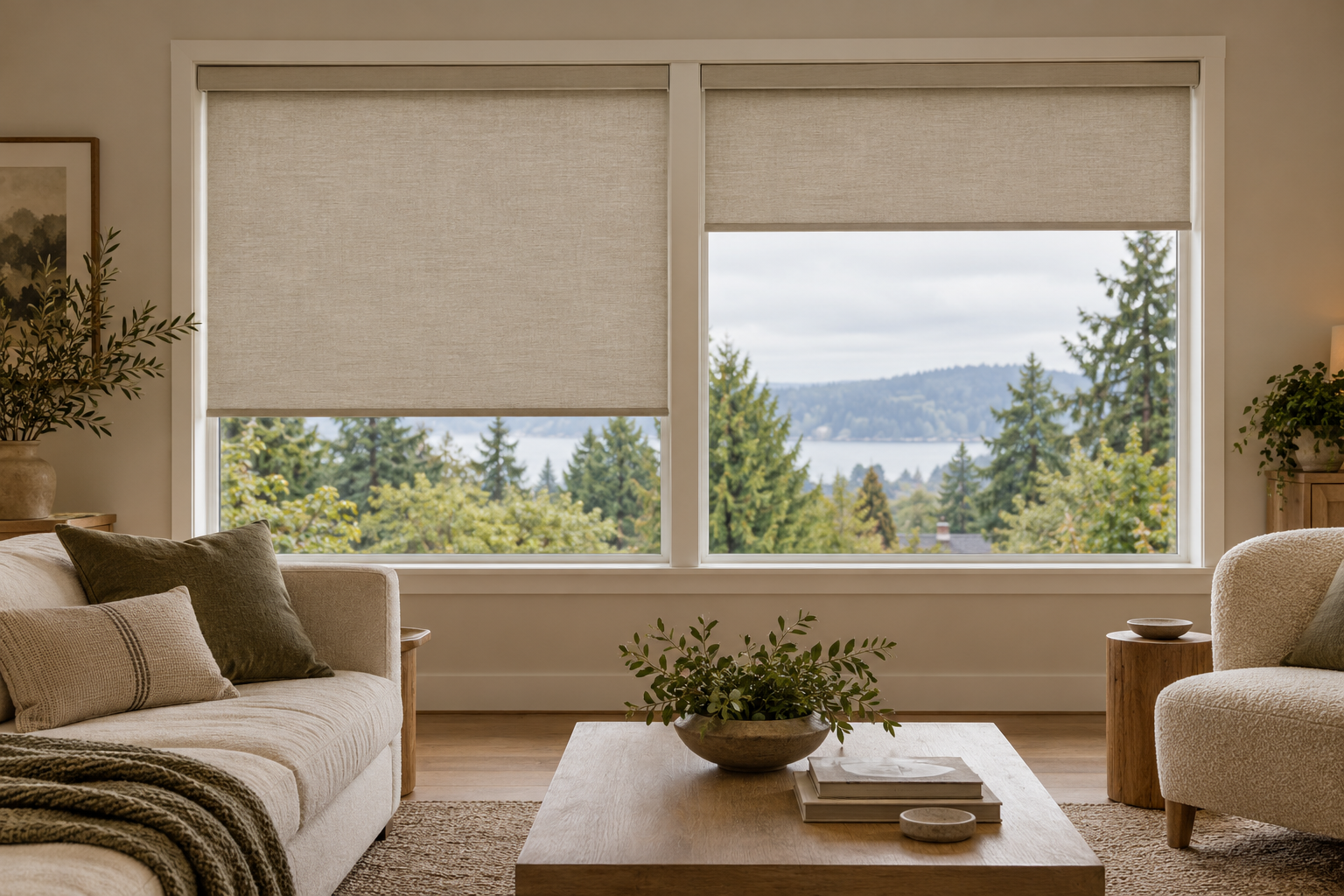
A wide window does not automatically need one wide shade. Two separate shades can let you cover the part of the glass that needs privacy or glare control while leaving the other side open. A single shade gives you one continuous surface, without a meeting point in the middle.
The right choice depends on how the window is divided, how you use the room, and what the selected product can support. Before choosing fabric for an Auburn living room or a Kent dining nook, compare both layouts at the actual opening.
Quick takeaways
- Choose one shade when a continuous appearance matters and you want the whole opening to move together.
- Consider separate shades when different parts of the window need different coverage.
- Ask where the fabric edges and center gap will land, not only where the hardware will fit.
- Confirm the exact shade, fabric, dimensions, mounting space, and controls before ordering.
Start with the way you use the window
Imagine an afternoon when the left side of your window puts glare on a chair, while the right side frames the garden. Two independently operated shades could let you lower one side and leave the other higher. With a single shade, the bottom edge moves across the entire opening at once.
That flexibility is useful only if you will use it. If you normally open everything in the morning and close everything together at night, one shade may be the simpler layout, provided the selected product is suitable.
Look at the window itself, too. Is it one uninterrupted pane, two equal sections, or a large center pane with smaller windows beside it? Let those divisions guide the conversation rather than assuming the opening should be split into equal halves.
Check where separate shades would meet
Two side-by-side shades introduce a meeting point. On a divided window, positioning it over the solid vertical frame between panes may make the separation less noticeable. On uninterrupted glass, the same division can stand out more clearly.
Ask to see the proposed fabric edges marked on a photo or sketch of your actual window. Then look from the sofa, dining table, and any angle where privacy matters. A frame behind the gap may help cover the direct view, but it does not automatically block light or views from every angle.
Roller shade fabric is narrower than its complete bracket-to-bracket assembly. Lutron's measuring guidance illustrates that distinction and shows that gaps vary with the system and configuration. Those dimensions are specific to Lutron products; they are not measurements for Rainier's shades. Ask for the expected gaps for the exact product in your quote.
If bedroom darkness is important, review the center meeting point along with the outside edges, top, and bottom. Blackout fabric alone does not answer those questions. Rainier's indoor shade page makes the same distinction between blackout fabric and the finished mount and fit.
Keep size and mounting decisions product specific
There is no single width at which every window should change from one shade to two. The available fabric, finished dimensions, hardware, and control configuration all need to work together. A general maximum width from another product does not establish what is available for your selection.
Ask whether your preferred fabric is available in the proposed one-shade layout, whether any seam or change in fabric orientation would be needed, and how that would look. If the answer changes your expectations, compare a different fabric or a divided layout before ordering.
For separate shades, the installer also needs an appropriate mounting plan near the meeting point. A visible window divider is not, by itself, confirmation that brackets can be fastened there. Check the complete installation, including depth, trim, handles, and the space needed for the shades to travel freely.
Decide how the shades should operate
Separate shades do not have to be at the same height. That is part of their usefulness. Decide whether you want each side controlled separately and whether you also want a convenient way to operate both together.
For motorized options, ask for a demonstration of the proposed control arrangement. A shared command and perfectly synchronized movement are different features. Hunter Douglas's guidance for its PowerView Gen 3 system, for example, explains that alignment depends on configuration and operating conditions. It is a useful reason to ask the question, not evidence that Rainier supplies that system or offers identical features.
Rainier confirms available controls for the selected shade at your consultation. If charging or other maintenance will be needed, plan access to each unit. A divided layout should not leave one shade difficult to reach behind furniture.
Compare the finished appearance and complete quote
With one shade, consider how the continuous fabric surface will look when fully lowered. With two, consider both the balanced appearance when the bottom edges align and the everyday appearance when one side sits higher.
For adjacent shades, confirm the fabric selection and orientation together. Ask how the cassettes or headrails will line up, and whether any differences between the two openings will be visible. A small fabric sample cannot show the whole arrangement.
Compare written quotes for the complete layouts rather than assuming two smaller shades will cost more or less than one large shade. Each option may use different hardware or controls. Keep the fabric, installation scope, and requested operation clear so you know what the price includes.
Questions to bring to your consultation
- Which part of the window needs coverage during the day?
- Where would the fabric edges meet, and what is behind that gap?
- Is the one-shade option supported in my chosen fabric and dimensions?
- What will the hardware and raised shade look like?
- Can separate shades operate individually and together as requested?
- How will I access each unit for routine maintenance?
- What changes between the two complete quotes?
Frequently asked questions
Will one wide shade make the room darker than two shades?
It removes a center meeting point, but the overall result still depends on the fabric, mount, and remaining gaps. Compare the complete light-control plan rather than choosing by shade count alone.
Do two shades have to be the same width?
Not necessarily. A layout can follow unequal window sections if the selected products and installation allow it. Ask for a sketch showing how the divisions relate to the glass and frame.
Is this the same as a dual shade?
No. This comparison is about side-by-side shades covering different parts of a window. Rainier's dual shade option uses sunscreen and blackout fabric layers to provide different light-control choices at the same opening.
Compare both layouts in your home
Rainier Blinds brings samples, measures your windows, and prepares a personalized quote. Our own crew handles measuring and installation. Ask us to compare a single shade with separate shades where both layouts are suitable.
Book an in-home consultation to discuss your indoor shades. Consultations are free within 60 driving miles of Auburn, WA, with no obligation to order. Farther-away projects are considered individually; any consultation fee is quoted before booking and credited toward your order if you proceed.