Cordless, motorized, or smart shades meet childcare safety codes for window shades; any shade with an exposed pull cord, bead chain, or continuous loop within a child's reach fails a standard licensing inspection in 2026. The detail most centers miss: a cord cleat or tension device lowers risk but doesn't guarantee a pass, because inspectors check for any accessible loop or dangling cord, not just the classic pull chain hanging at knee height.
- Cordless, motorized, or smart shades are the only options that reliably meet childcare safety codes for window shades in 2026.
- Traditional corded lift shades fail most licensing inspections because the cord itself is the strangulation hazard.
- Cord cleats and tension devices reduce risk but do not guarantee a pass since inspectors flag any accessible loop.
- Motorized and smart shades remove the cord entirely and add scheduling control for naptime and glare.
- Rainier Blinds measures and installs cordless, motorized, and smart shades for childcare centers across the Greater Seattle Area.
Why this matters
Corded window shades have been flagged as a strangulation hazard for young children for decades, and the window covering industry responded with a voluntary cordless standard, ANSI/WCMA A100.1-2018, that made ready-made shades sold in the U.S. cordless by default starting in 2018. Licensed childcare facilities get held to that same bar during routine health and safety inspections, and a classroom or infant room with an old corded lift shade is one of the easier items for an inspector to catch.
Centers that operate in window treatments for daycare and childcare centers settings across South King County run into this most often during licensing renewal, when a facility that passed inspection five years ago with corded shades now needs a swap before the license clears. Waiting until renewal week to deal with it is the expensive way to handle it.
How do you meet childcare safety codes for window shades?
The fastest way to see where a shade type lands is a straight comparison. Every option below is a shade, not a blind or shutter, since those product categories don't carry the same lift-system distinctions.
| Shade type | Exposed cord or chain | Typical inspection outcome | Best for |
|---|---|---|---|
| Traditional corded lift | Yes | Fails most inspections | Not recommended for any licensed childcare space |
| Cordless manual | No | Passes when mounted correctly | Budget-conscious classrooms and small rooms |
| Motorized | None | Passes, no retrofit needed later | High or hard-to-reach windows, infant rooms |
| Smart (app or schedule controlled) | None | Passes, plus automated light control | Centers that want naptime dimming without staff involvement |
Verdict: cordless manual shades pass the code, but motorized and smart shades are the only options that never need revisiting once installed.
Cordless manual shades: compliant when mounted correctly
A cordless manual shade uses a spring lift or a clutch system instead of a pull cord, so there's nothing dangling for a toddler to reach. It passes inspection on its own, but the mounting matters: a cordless shade installed with slack in the fabric or a loose bottom rail can still create a pinch point an inspector notes. This is the lowest-cost route to compliance and works fine for standard classroom windows under 6 feet wide.
Motorized shades: no exposed lift cords, one-time install
Motorized shades run on a battery or hardwired motor and operate from a remote or wall switch, so there's no cord, chain, or loop anywhere on the unit. For infant rooms and windows above cribs or changing tables, this removes the guesswork entirely, since staff never touch a cord to open or close the shade. The tradeoff is a higher install cost per window, which centers with large window walls or multiple classrooms should plan for ahead of a licensing renewal, not during it.
Smart shades: compliant plus scheduling control
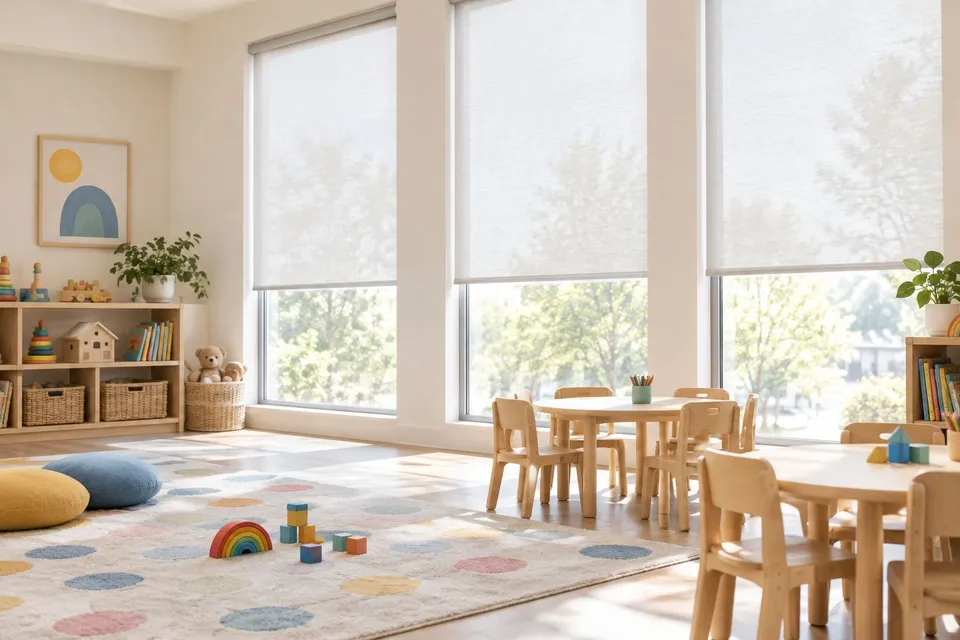
Smart shades add app or hub scheduling on top of a motorized lift, so a center can set shades to lower automatically at nap time and raise again at pickup without a staff member walking the room. They meet the same cordless standard as motorized shades and add a convenience layer that larger centers with multiple classrooms tend to value more than a single-room daycare would. The extra cost is in the control system, not the safety compliance itself.
Why compliance requirements vary
Not every childcare space needs the same fix, and a few factors decide how far a center has to go:
- Facility type: a licensed daycare center, a family home daycare, and a preschool classroom can fall under different licensing checklists even within the same state.
- Window height and reach: a ground-floor window a toddler can touch gets scrutinized harder than a high transom window an infant can't reach.
- Existing construction vs. new build: retrofitting an older building with corded shades already installed takes more coordination than specifying cordless or motorized shades in new construction from the start.
- Licensing renewal timing: inspectors flag non-compliant window coverings during scheduled renewals, so the timeline for fixing it depends on when the center's license comes up.
- Room use: infant rooms and napping rooms usually get more attention than administrative offices within the same building.
Get a compliance-ready shade quote
Free in-home measure and consultation for childcare centers across the Greater Seattle Area.
Are corded shades banned outright in daycare centers?
Corded shades aren't federally outlawed for every building type, but a corded shade with an exposed pull mechanism fails nearly every childcare licensing inspection in 2026 because the cord itself is the flagged hazard, not the shade material or fabric. Replacing it with a cordless, motorized, or smart shade resolves the issue permanently instead of requiring a workaround at every renewal.
What counts as a childcare facility for these codes?
Any licensed childcare setting where children can physically reach a window covering counts, including in-home family daycares, standalone centers, and preschool classrooms inside larger buildings. The trigger isn't the building type; it's whether a child under supervision can reach the shade's cord or chain.
Can existing corded shades be retrofit instead of replaced?
Yes, some corded shades can be retrofit with a cordless lift kit or converted to a motorized system without a full window treatment replacement, though the option depends on the shade's existing hardware and mounting. A quick on-site look during a measure appointment usually settles whether retrofit or full replacement is the faster path.
FAQ
What shades meet childcare safety codes for window shades in 2026?
Cordless, motorized, and smart shades meet childcare safety codes for window shades in 2026, since none of the three have an exposed pull cord, chain, or loop a child can reach. Traditional corded lift shades are the type that fails inspections.
Do cord cleats make a corded shade compliant?
A cord cleat or tension device reduces risk but doesn't guarantee a compliant result, because inspectors look for any accessible loop, not just a dangling cord. A cordless or motorized shade removes the question entirely.
Is motorized more reliable than cordless manual for compliance?
Both pass inspection, but motorized shades have zero cord to begin with, while cordless manual shades depend on correct mounting to stay compliant. Motorized is the lower-maintenance choice for infant rooms and hard-to-reach windows.
How often do childcare centers get re-inspected for window shades?
Inspection timing depends on the center's licensing renewal schedule, not a fixed calendar date tied to window shades specifically. Centers usually get flagged for non-compliant shades during a scheduled renewal visit.
Can a single classroom mix cordless and motorized shades?
Yes, mixing operation types by room is common, with motorized shades reserved for infant rooms or high windows and cordless manual shades used in standard classrooms. Both operation types meet the same underlying code requirement.
Do blackout shades for classrooms need to be cordless too?
Yes, blackout shades follow the same cordless requirement as any other shade type in a childcare setting, since the hazard is the cord, not the fabric's light-blocking properties. A cordless or motorized blackout shade meets the code the same way a light-filtering shade does.
One last thing
The centers that end up redoing a window treatment twice are almost always the ones that installed cordless manual shades to pass an inspection quickly, then discovered during the next renewal that a motorized or smart upgrade would have saved a second install visit. If a childcare center has infant rooms, high windows, or plans to add classrooms, motorized shades installed once in 2026 avoid a repeat project later.