
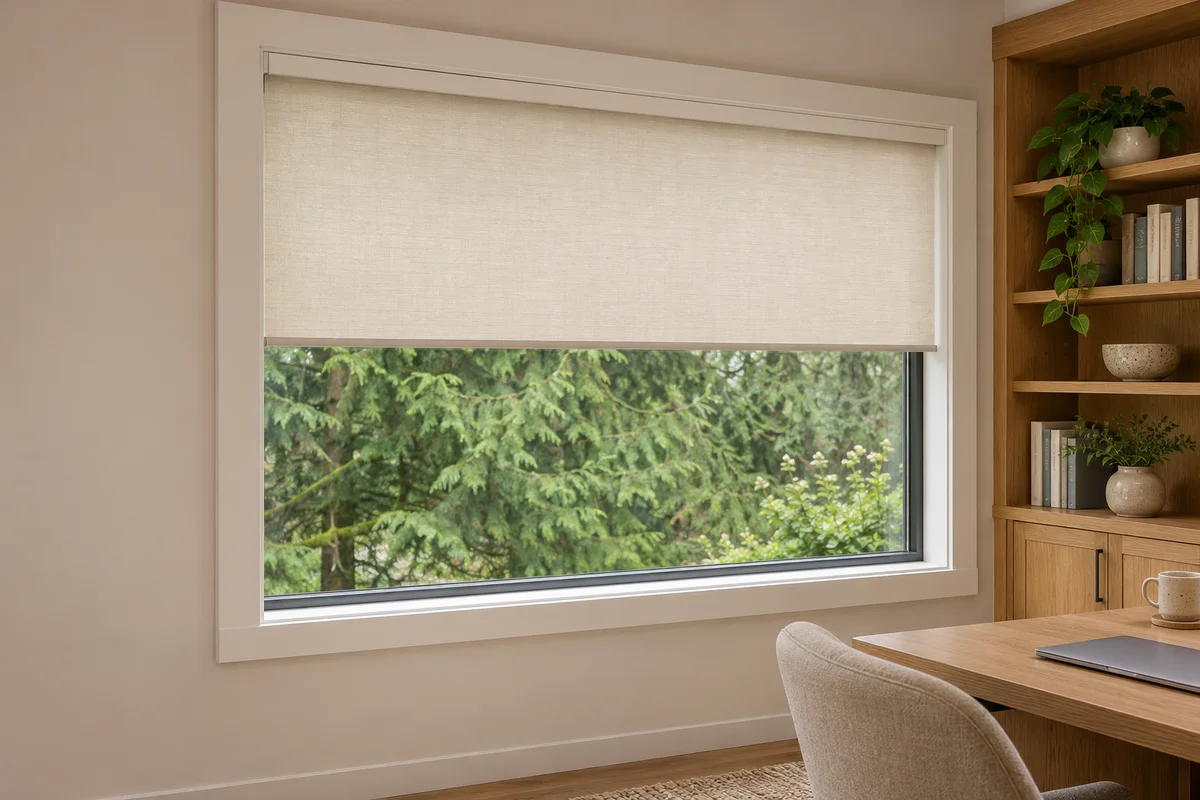
A remote lets you raise a roller shade from across the room. It doesn’t make the charging connection any easier to reach. If one end of your shade sits beside a tall cabinet or behind a drapery panel, the side you choose can matter long after installation.
For a rechargeable shade, start with the side you can reach comfortably and where the charger can connect without getting in the way. Then ask whether that side is available on the exact shade you’re ordering. If you’re planning a wired shade as part of a remodel, start with where the power will come from instead.
Quick takeaways
- Check where the charging connector actually sits on your selected shade.
- Compare access with furniture, trim, and drapery in their normal positions.
- If you’re planning wired power, confirm the cable exit before walls are closed.
- Confirm what left and right mean on the order, window by window.
Start with how you will charge the shade
Where would you stand to plug it in? Is there room for your hand and the connector? Can you reach an outlet with the approved charger without running the cord across a walkway? Those questions are more useful than just picking whichever side is closest to an outlet on the floor plan.
The layout varies by model. For example, the rechargeable motor described in our shade remote guide charges at the motor end of the shade tube. That’s an example, not a rule for every shade. Ask your installer to show you where yours connects and whether you’ll be able to reach it after the shade and its fascia are installed. A fascia is the cover that hides the roller at the top.
Look at the window with the room set up
Imagine a South Sound home office with built-in shelves tight to the right side of the window and open wall space on the left. The left may be easier to reach, even if the right outlet is a little closer. On another window in the same room, the better side could be the opposite.
Look for anything that narrows access near the top: a cabinet, a return wall, deep trim, or a curtain panel that gathers against the shade. If drapery will sit in front, check the opening with the panels parked where you’d normally leave them. Bring photos or plans if the cabinets or drapery aren’t in yet.
If neither side is easy to reach, say so at the consultation. For a tall stairwell window or a shade over a deep built-in, the more useful decision may be changing how the shade is powered or how the charging point is accessed, if the selected system allows it.
Confirm the power plan before drywall
For a wired setup, don’t assume the wire can enter from either end or that the motor and cable exit are always on the same side. Manufacturers can offer different power configurations within a roller shade line. Have the shade installer confirm the electrical requirements and the exact cable exit for the selected system, then share that information with your electrician before wiring is roughed in.
On a retrofit, start with what’s already in the room. An outlet on the opposite side of the window doesn’t automatically rule out a rechargeable shade. It does mean it’s worth planning how you’ll connect the charger before you order.
Write the side down for each opening
At the consultation, stand inside the room facing the window and point to your preferred end. Use that viewpoint to explain the room, then have the installer confirm how the manufacturer labels the side on the order. For two windows, record each separately: for example, “office, window beside bookcase, open-wall end.” A labeled photo helps if there are several similar windows.
Before the installer leaves, ask them to show you how to connect the charger or explain how the wired setup is powered. Check that you can get to the connection with the furniture and drapery where they normally sit.
Frequently asked questions
Does the side have to match across the room?
Not necessarily. Start with what makes sense at each opening and ask which choices the selected system allows. If both ends are equally accessible, ask the installer whether anything about the mount or power path favors one.
Can I switch the side after installation?
Don’t count on it. Ask whether the exact roller system is reversible before ordering. The answer can depend on the hardware and power configuration.
Plan the motor side at your consultation
Rainier Blinds brings samples, measures your windows, and confirms the available controls for your selected indoor shades. If you aren’t sure where charging or power should go, show us the outlets, furniture, and trim at your in-home consultation. Consultations are free within 60 driving miles of Auburn, Washington. For projects farther away, any consultation fee is quoted before booking and credited toward your order if you proceed. See our consultation FAQ.