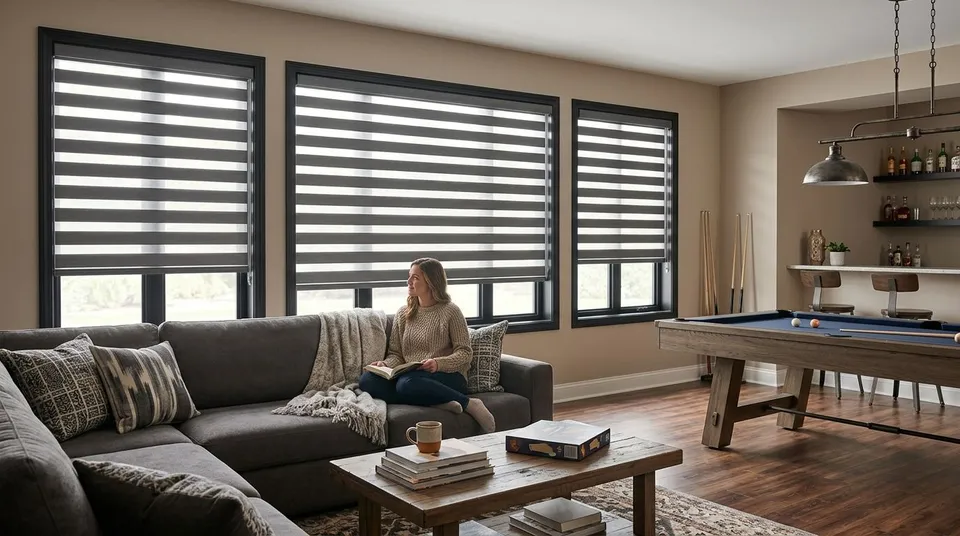
Basement rec rooms bring three problems most upstairs rooms don't have: low natural light, below-grade humidity, and windows that often double as egress exits. Here's how to pick zebra shades that solve for all three in 2026.
Best overall for basement rec rooms: motorized dual-layer (day/night) zebra shades — one remote press shifts the alternating stripe from sheer to opaque, which matters when the same room hosts a poker night and a kid's movie afternoon. Best for home theater corners: blackout-backed zebra shades that kill screen glare completely. Best for egress and daylight basement windows: manual cordless zebra shades that meet basement safety code without a dangling pull cord. Best for damp or humid basements: moisture-resistant zebra shade fabric that resists mildew and sag. Best budget option: manual light-filtering zebra shades on a standard alternating-stripe fabric.
- Motorized dual-layer zebra shades are the best overall pick for basement rec rooms with mixed daylight and movie-night use.
- Blackout-backed zebra shades are the right call for home theater corners and screen walls.
- Manual cordless zebra shades meet egress code on basement exit windows without a hanging cord.
- Moisture-resistant fabric belongs on any basement window that runs damp for part of the year.
- Rainier Blinds measures and installs every configuration in the Greater Seattle Area with its own crew, not a subcontractor.
Why this matters
A basement rec room isn't a bedroom with worse light. It's a room where you're watching TV at 2pm on a gray Tacoma afternoon, hosting a game night at 9pm, and possibly using an egress window as the only fire exit for that level of the house.
The wrong zebra shade configuration means glare on the screen, a cord hazard near an exit window, or fabric that sags after one wet Pacific Northwest winter. Rainier Blinds installs custom zebra shades across Auburn, Kent, Tacoma, Bellevue, and the rest of South King County, and basement rec rooms are one of the more common calls in 2026 because more homeowners are finishing that square footage instead of moving.
What makes the best zebra shades for basement rec rooms
- Light control range — the stripe has to go from near-blackout to sheer, not just one fixed opacity
- Cord-free operation on egress windows — a corded shade blocking an emergency exit is a code problem, not just an inconvenience
- Moisture tolerance — basements run humid seasonally even with a working dehumidifier
- Motorization option — a rec room often has furniture blocking direct window access, so a remote or app matters more here than upstairs
- Compatibility with layered drapery — some basements want a drapery panel over the shade for sound dampening during movie nights
At a glance
| Configuration | Best for | Standout feature | Key limitation |
|---|---|---|---|
| Motorized dual-layer zebra shades | Media walls and open-concept rec rooms | One-touch fabric shift from sheer to opaque | Needs a power source or hub nearby for full smart control |
| Blackout-backed zebra shades | Home theater corners and screen walls | Blocks daylight glare from basement windows completely | Loses the sheer daytime setting entirely |
| Manual cordless zebra shades | Egress and daylight basement windows | No cord near a window used as a fire exit | Reached by hand, not by remote |
| Moisture-resistant zebra shade fabric | Basements with seasonal humidity or dampness | Coated fabric resists mildew and fabric sag | Fewer color options than standard sheer fabrics |
| Manual light-filtering zebra shades | Budget-conscious basement refreshes | Alternating sheer/opaque stripe on standard fabric | Less light control than blackout-backed versions |
1. Motorized dual-layer zebra shades: best zebra shades for basement rec room media walls
Dual-layer zebra shades alternate sheer and solid bands on the same fabric roll, and the motorized version lets you shift that alignment from across the room. For a rec room with a TV or projector wall, that means killing glare in seconds without walking to the window.
Motorized dual-layer zebra shades pros:
- One remote or app press moves from sheer to near-blackout
- No cord anywhere near the window, which matters in a room full of kids and pets
- Pairs with a smart home hub for scheduled openings
Motorized dual-layer zebra shades cons:
- Needs a nearby outlet or a battery pack that gets recharged periodically
- Costs more to install than a manual version of the same fabric
Best for: rec rooms that double as a media wall, home bar, or open hangout space with mixed daylight needs.
Verdict: Buy. This is the default pick if the room gets both daytime use and movie nights on the same window.
2. Blackout-backed zebra shades: best zebra shades for basement home theater corners
A blackout-backed zebra shade swaps the sheer band for a fully opaque liner, which matters if you've dedicated one corner of the basement to a projector screen or a home theater setup. See how the same logic applies above ground in the blackout curtains for home theaters guide.
Blackout-backed zebra shades pros:
- Full daylight block for screen visibility, even on a bright afternoon
- Still works as a normal light-filtering shade when raised partway
- Available in manual or motorized operation
Blackout-backed zebra shades cons:
- Loses the true sheer setting that dual-layer fabric offers
- Overkill for a rec room that doesn't include a dedicated screen wall
Best for: the specific corner or wall where a projector or large TV lives, not the whole room.
Verdict: Buy for the screen wall. Skip for the rest of the room if daylight matters there.
3. Manual cordless zebra shades: best zebra shades for basement egress and daylight windows
Many finished basements have at least one egress window, and that window can't have a cord hanging across it. A cordless zebra shade operates by hand, top-down or bottom-up, with nothing dangling in front of the exit path. Details on meeting code for that specific window type are in the basement egress window compliance guide.
Manual cordless zebra shades pros:
- No cord obstruction near an emergency exit
- Lower cost than motorized versions of the same fabric
- Simple operation that doesn't rely on batteries or Wi-Fi
Manual cordless zebra shades cons:
- Requires reaching the window directly, which is harder if furniture sits close to it
- No remote or schedule automation
Best for: any basement window that also serves as a fire exit.
Verdict: Buy. Non-negotiable on an egress window regardless of what's chosen for the rest of the room.
4. Moisture-resistant zebra shade fabric: best zebra shades for humid or damp basements
Basements in the Puget Sound area run humid for months at a time even with a dehumidifier running. Standard sheer fabric can sag or mildew under sustained moisture, so a coated, moisture-resistant zebra fabric holds up better over multiple wet seasons.
Moisture-resistant zebra shade fabric pros:
- Resists mildew growth in a way standard fabric doesn't
- Holds its shape instead of sagging after repeated humidity swings
- Works in manual or motorized configurations
Moisture-resistant zebra shade fabric cons:
- Narrower color and pattern selection than standard fabric lines
- Not necessary in a basement with strong, consistent dehumidification already in place
Best for: below-grade rooms with visible condensation, musty smell, or a history of dampness.
Verdict: Buy if the basement has any humidity history. Hold if the space stays consistently dry year-round.
5. Manual light-filtering zebra shades: best budget zebra shades for a basement refresh
This is the standard alternating-stripe zebra shade without blackout backing, moisture coating, or motorization. It still gives real light control for a rec room that just needs privacy and glare reduction, not a full media setup.
Manual light-filtering zebra shades pros:
- Lowest-cost entry point into the zebra shade category
- Still adjusts opacity by aligning the sheer and solid bands
- Straightforward manual operation
Manual light-filtering zebra shades cons:
- No true blackout setting for screen glare
- No motorization or humidity coating
Best for: a basic basement refresh where full media control isn't the priority.
Verdict: Buy for a straightforward rec room. Wait if the room will eventually get a screen wall — the blackout-backed version is worth the upgrade later.
How we ranked these
Each configuration was matched to one basement-specific problem: glare control, egress safety, humidity, and cost, rather than stacked against each other as if they compete for the same slot. That's the same criteria list from earlier in this guide, applied item by item instead of as a single leaderboard.
“If a basement window doubles as an emergency exit, cordless operation isn't a preference, it's the only configuration that clears the escape path.”
Which zebra shades should you choose for your basement rec room?
For most finished basements in 2026, motorized dual-layer zebra shades cover the widest range of daily use without a second product. Add blackout-backed fabric specifically on the wall behind the screen, keep cordless manual operation locked in on any egress window no matter what else you choose, and upgrade to moisture-resistant fabric the moment there's any sign of seasonal dampness.
Get a free basement shade consultation
Rainier Blinds measures and installs zebra shades with its own crew, not a subcontractor.
FAQ
What are the best zebra shades for basement rec rooms in 2026?
Motorized dual-layer zebra shades are the best overall pick for 2026 because they shift from sheer to near-blackout with one remote press, covering both daytime use and movie nights on the same window.
Are zebra shades good for basements with little natural light?
Yes, the sheer setting on a zebra shade lets in available daylight while still filtering glare, which works well in a basement that already has limited natural light.
Do zebra shades work on egress windows in a basement?
Manual cordless zebra shades work on egress windows because they operate without a dangling cord that could obstruct the exit path during an emergency.
Can zebra shades handle basement humidity?
Standard zebra fabric can sag or mildew under sustained basement humidity, so a moisture-resistant coated fabric is the better choice for damp or seasonally humid spaces.
What's the difference between motorized and manual zebra shades for a rec room?
Motorized zebra shades adjust by remote or app, which matters when furniture blocks direct access to the window, while manual versions cost less but require reaching the shade by hand.
Are zebra shades better than roller shades for basement rec rooms?
Zebra shades give a wider range of opacity control through the alternating stripe design, which makes them better suited to a rec room that needs both daytime light and blackout for screen use.
How much light control do zebra shades give a home theater setup?
Blackout-backed zebra shades block daylight glare on a screen wall almost completely, while still functioning as a normal light-filtering shade when raised partway.
Can smart zebra shades sync basement lighting for movie nights?
Motorized zebra shades that pair with a smart home hub can run on a schedule alongside other basement lighting, though the shade itself doesn't control the lights directly.
One last thing
Measure the shade drop with someone seated in the actual viewing spot, not standing at the window. Basement rec room windows usually sit closer to eye level for someone on a couch than they do in an upstairs room, so the stripe alignment that looks right standing up can land at the wrong height once everyone's seated for movie night.